"Give them the gift of words"

Ultimate Vocabulary EDU is the world's most advanced vocabulary learning system for schools. With Ultimate Vocabulary, you have your vocabulary teaching requirements completely under control.

Based on proven principles of cognitive science, Ultimate Vocabulary EDU contains all the features of Ultimate Vocabulary plus:

It's absolutely essential your students graduate with their vocabulary educational requirements met. With Ultimate Vocabulary EDU these vocabulary requirements are more than met. Students also improve academic performance, are prepared for standardized tests, and improve their confidence.

The next step is to see Ultimate Vocabulary for yourself. Simply fill out the form and we'll send you a free no obligation trial of the full version of Ultimate Vocabulary EDU.

The Apostrophe Unmasked! (Guest Post)


The apostrophe has two main functions.

The first is to show omission of letters and the second is to show possession, which is what we’ll look at here.

Using the apostrophe to indicate possession

It’s easy when you write about the dog’s dinner; the man’s stunningly beautiful wife, Lavinia; Lavinia’s personal trainer, Lars, and so on.

It starts to get tricky (for Lavinia’s husband and for us) when we get to Lars. Is Lavinia Lars’ best client? Could it be that she is Lars’s ticket to that new Porsche he’s had his eye on for some time?

If he was plain old Bill there wouldn’t be a problem — she would be Bill’s best client and the ticket to Bill’s new Porsche.

We’ll assume (rightly, as it happens) that Lavinia is a Lady Who Lunches, and when she does lunch with her friends, they visit a women’s club. It’s not a womens’ club. When a word is made plural by changing some of its interior bits, you don’t make it doubly plural in the possessive.

When a word ends in ‘s’ and an additional syllable is pronounced in the possessive, add apostrophe S (even if you end up with 3 s’s). So you’d have the ladies going to their tennis class before lunch, and Lavinia being very chuffed when her coach, Mr Harris, told her she was the class’s best player. Although it’s difficult to know whether Mr Harris’s opinion is very reliable — he’s a push-over for a pretty face and a flash of a shapely thigh.

When writing about joint ownership, possession is shown only on the last noun, but where individual ownership exists, possession is shown on each noun.

Lavinia and her husband’s new yacht was the venue for a fancy-dress party.

Lavinia’s and Raoul’s sailor suits were a hit with their guests.

T’riffic Tip

The very best way to remember when to use the possessive apostrophe — in any circumstance — is to substitute the word ‘of’ …

The women’s club – the club of the women

Lavinia’s personal trainer – the personal trainer of Lavinia

Her husband’s new yacht – the yacht of her husband

This is also the way you test for those really tricky ones:

three months’ experience – the experience of three months

So, if you’re tempted to use an apostrophe but you can’t substitute “of” … then leave it out!

Banana’s only $2 kilo – the … of … bananas, kilos? … @#!

All these shop’s sell clothes – the … of … shops, clothes? … @#!

OK … you get the message. Don’t just whack in an apostrophe every time you end a word with S!

About the Author: Jennifer Stewart is a freelance writer whose site, http://www.write101.com has been helping people solve their writing problems since 1998. Visit now to read numerous articles on how to write well — for profit or pleasure — and sign up for your free Writing Tips: mailto: WritingTips -subscribe@yahoogroups.com

Originally Posted at http://www.write101.com, July 13, 2001

Aspiring English language teachers – Vietnam awaits… (Guest Post)


There are very few lines of work where it’s possible to see tangible results for your effort in a relatively short period of time – teaching English in a developing country like Vietnam is certainly one of them.

If you have an internationally recognised TESOL certificate, a clean criminal record and reasonable health, there’s a paid English teaching job in Vietnam waiting for you. While a university degree coupled with a TESOL certificate will certainly open more doors, the demand for native English speakers with teaching skills means there are plenty of opportunities for people without a degree.

Even though the number English teaching jobs that are available in Vietnam outstrips the number of native English speakers who are available to fill the positions, most schools are reluctant to employ teachers who aren’t already ‘in-country’. There’s no doubt that fronting up in a country like Vietnam without a confirmed job is a bit of gamble, but it’s a road that many people have successfully travelled down before – including me. Taking a risk or two surely adds to the adventure.

The vast majority of aspiring teachers rely on the internet to identify and apply for English teaching jobs because it doesn’t require much effort, but there’s a problem with this strategy in my view – time! It can take 2 weeks (plus) from when you submit your curriculum vitae (CV) via the net to an actual start date. This assumes of course your CV stood out in the first instance among the 100 or so other CV’s the school or recruiter received electronically for the same teaching job.

My tip is very simple, but it works: 1. run off copies of your CV; 2. identify schools within a reasonable distance of where you’re staying; and 3. physically call into the schools and ask to speak with the Director of Studies.

If the Director of Studies is unavailable, ask for his (or her) name and leave a message noting that you called-in – and your phone number. If the Director of Studies doesn’t call you within 2 days, call the school and ask to speak to him (or her) by name. If necessary, leave another message

With this direct approach, in most instances, you’ll land some teaching hours within a day or so. You’ll then be the one who’s seeing tangible results for your efforts. Enjoy!

About the writer: Peter Goudge is the Managing Director of the Australia-Vietnam School of English (AVSE) and Teaching English – Vietnam. Both companies are located in Ho Chi Minh City, Vietnam.  Originally from Melbourne, Australia, Peter Goudge now lives and works in Ho Chi Minh City.

Get the Most Out of Learning (Guest Post)


by Rene Kondratzky of vokabel.com


The inscription outside of the Oracle at Delphi informed truth seekers to “Know Thyself”, perhaps to help them solve issues on their own without having to consult the Oracle. We can also use the Oracle’s advice in modern times to help us in our learning experience. The branch of philosophy called epistemology tries to address the issue of what happens when we process various inputs that eventually become, what we call, knowledge. In this blog entry, I’ll briefly discuss some epistemological concepts that help me in my lifelong search for truth.

At my website, http://www.vokabel.com, I use the concept that, just like a computer, we have memory readily available for tasks that require immediate processing (i.e. RAM). As well, we have a much larger store of memory available which has much longer access times. Language learners know the frustrations when trying to speak and not being able to pull up “that word” in time to add to a conversation. The vocabulary tests try to load words from deep memory into near memory for quicker recall through the repeated taking of the tests.

Have you ever heard someone say “I’m just not good at math”? This may be true, but I found that a different approach to learning math may help these people. In our day-to-day lives we tend to perform tasks inductively, that is, we walk around with a predetermined amount of knowledge and when a problem presents itself that cannot be dealt with using the knowledge that we have, we apply new tools or knowledge to our existing base to help deal with the issue. We don’t, from scratch, try to deductively solve a problem. The “classic problem” approach helps those making the jump from high school algebra (who often only use the deductive approach) to university calculus by having students essentially memorize classic problems and proofs and then apply this new knowledge to new math problems that present themselves. Why this approach is not used earlier is unclear to me but I think it may help math learners at all levels. A future project on the website will be a collection of classic math problems.

I work in the Information Technology field where a common mantra is “learn by doing”. It is very rare that someone will learn the syntax of a programming language and then go to work on building a big project. There are many other elements involved and it is usually best to replicate the “classic problem” approach used when learning mathematics than to reinvent the wheel. On the site, I’ve created pages that present a classic problem of building and publishing iOS and Android self-testing apps. In a future project, I hope to address the classic problem of accessing and serving data across the internet through SOAP web services.

Immanuel Kant, possibly the greatest of all epistemologists, divided knowledge that was hardwired into us such as logic, mathematics, and memory from knowledge that can only be obtained through intuition (i.e. an input that resonates with intuition which becomes knowledge). Unfortunately this step of knowledge discernment against our own intuition is often skipped in the learning of disciplines such as the humanities and metaphysics. This is often exacerbated in universities by overloading the students with work and using teaching material such as video which leaves little time for discernment of the information that was just presented (unless the pause button is repeatedly pressed).

For the experimental sciences, we simply do not have enough hours in the day to replicate each experiment. We must therefore take the information at face value and assimilate it with our current knowledge base. This method of learning is often referred to as the Hegelian Dialectic where we combine an input (antithesis) with our current knowledge base (thesis) and come up with a new way of seeing things (synthesis). On the other hand for the physical sciences, the “classic problem” approach fits quite well.

Learning can be a rich experience that I am saddened to see seems to have lost a lot of its lustre in my lifetime. Hopefully by applying epistemological principles to the learning process we can make it more fun and enriching for everyone.

Don’t Be Afraid of These 3 Weird Words!


Some words create warm and fuzzy feelings when we hear them: lullaby, chocolate, firelight. Other words send shivers down our spine: alligator, zombie, thunderstorm. But what is it about words that makes us have these unconscious reactions? Part of it is experience – anyone who has been startled by a snake will automatically think of that moment the next time they hear the word, and a cold winter snuggled under a warm blanket brings back memories whenever you read the word “comforter.”

Researchers recently found a possible link that explains trypophobia, or “fear of holes.” In a study done by Geoff Cole at the Centre for Brain Sciences at the University of Essex in England, images of things like a blue-ringed octopus or a lotus seed pod can set off fear reactions in people, and that this emotion may be connected to the fact that many poisonous plants and venomous animals have rings or other brightly-patterned coloring that would have warned off our earliest ancestors. In the depths of our brains, we still connect those patterns with danger, even when we’re looking at something as harmless as a piece of Emmentaler cheese.

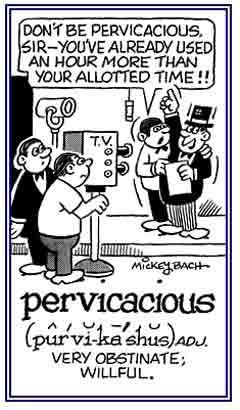
Sometimes the same word can be used to mean something that’s both good and bad. For example, if you’re pervicacious, it means that you’re very stubborn. On the other hand, if you look at the word’s etymology, you’ll see that it comes from the Latin root vincere, which is the same root that gives us the words victorious and invincible. Being stubborn for the right reason can lead to good things. Hold firm to your resolution to improve your vocabulary, and you’ll come out a winner in the end.

Nourish your vocabulary and you won’t have the conversational equivalent of a nutrient deficiency. People and animals who practice geophagia (literally “dirt-eating”) generally do so because there’s something missing in their diets. Minerals like calcium or iron, and substances like salt, are found in soil, mud, and cliff faces where elephants, parrots, and even butterflies will eat and lick the ground to get the supplements not found in the plants and fruits they eat. If you make sure to get your daily dose of words, you’ll have a healthy vocabulary, and will be hungry for more good words.

What’s the One Word Everyone Uses and Understands?


“I’m sorry, could you repeat that?”

“What did you say?”

“Did I just hear what I think I heard?”

No matter where you are or what language you’re speaking – and especially if you’re someplace where you don’t speak the local language – you’ll no doubt find yourself using one of these phrases, or something like them. Or if you’re like people everywhere, you’ll just say one brief syllable …

Huh?

… and you’ll be understood. According to a new study done by researchers and linguists in The Netherlands the sound of the question word used to mean “please repeat what you have just said because I didn’t understand it” in many languages around the world is very similar. They’ve proposed that it’s a nearly global bit of language, and might actually be tied to the earliest form of language, one that humans all spoke in the days when spoken language was first beginning. While there are some differences to exactly how the “question sound” is expressed the one-syllable word has essentially the same pronunciation. In other words, although people in Iceland say “ha” with a downward-falling inflection, and people in Japan say “ei” with an upward inflection, all of the languages the researchers looked at had approximately the same syllable for this questioning sound: a vowel with or without the “h”-sound at the beginning, and without a closing consonant sound.

English has become a global standard for communication, but if you’re traveling you’ll still come across situations where you can’t understand other people, and they can’t understand you. It’s a good idea to improve your English to help you communicate around the world, and to learn another language like Spanish or Mandarin to better relate to people in other countries and improve your job prospects, but it’s nice to know that no matter where you go, there’s at least one word that everyone will understand.

You can read the full article on this study at the online journal PLOS ONE.

How to Make Learning English Easier


There are many reasons to learn to speak English, and to build up a good vocabulary for use in both your professional and your everyday life. If you were born in an English-speaking country, then your vocabulary started growing from an early age, and you probably learned how to spell English words as you added them to your vocabulary. There are challenges that even native English speakers face when it comes to both spelling and vocabulary, and those challenges can be even more difficult for people who are learning English as a second language, especially as adults. Here are some ideas for how you can make it easier to study English, whether you’re the student or you’re helping someone else:

Take advantage of the resources around you. A supportive learning community is critically important for learners, whether they’re adults or children. However, many adults feel uncomfortable in what they see as “beginner” classes, and might be embarrassed to make mistakes in front of other people. It’s important to remember that ESL classes provide good study materials, a chance to practice the language with other people, and a teacher who can help with any questions. Look for community college courses, or free classes which are often organized by libraries, churches, or social services organizations. If your child isn’t getting enough English practice in their school, these classes are a good way to help them keep up with the other students.

Use games to make learning fun. Spelling games are great ways to keep kids interested and occupied, and the challenge and interactivity will keep them involved in the learning process. They’ll be having so much fun, they’ll forget they’re actually learning something! Learning vocabulary is fun and easy if you have a “word of the day” app that you can download onto your smartphone, or set up to run on your computer at work. You can also practice both spelling and vocabulary skills by doing crossword puzzles – one of the daily crosswords published on line and in many local newspapers is usually short enough to complete during a lunch break or on your commute.

Stay focused on your goals. It’s hard to make enough time in an already-busy day to improve your literacy skills, but you’ll get your motivation back when you think about all the ways that a good vocabulary will help you get ahead at work. It’s sometimes harder to keep children motivated towards an intangible (to them) goal of success in school, so use rewards that they can appreciate right away for their time spent working on their spelling lists or English homework. Every goal, whether short-term or long-term, should be celebrated when it’s met. Even adults need a reward, so when you’ve finished your class or made it through your vocabulary list, give yourself a treat or a break, and get your energy back for the next step in your self-improvement program.

Cross-posted at the Ultimate Spelling blog.

Word of the Day: Aphorism


Almost every wise saying has an opposite one, no less wise, to balance it.
– George Santayana (1863-1952)

If you want to be someone that other people look up to, and go to for advice, then you need to words to express the knowledge that you have to share. A good vocabulary is essential, because with a wealth of words to draw on you’ll always have the right ones for any situation. Being able to come up with the perfect phrase at just the right moment is a hallmark of both education and erudition. Many well-known writers and philosophers were praised for their skill with words, and their aphorisms are remembered and shared today.

An aphorism is a wise saying. Technically, only the original speaker of that saying or phrase has uttered an aphorism; once the saying is repeated over and over, it is more commonly referred to as a maxim, although the two terms are now fairly interchangeable.

If you desire many things, many things will seem but a few.
– Benjamin Franklin (1706-1790)

The word aphorism was first used in the 16th century in English, and has its roots in the Greek word horizein, meaning “to limit” or “to set a boundary.” Essentially, an aphorism is a phrase that contains a complete thought, set apart from other phrases because of its originality. If you want to set yourself apart from the rest of the crowd, you’ll need to develop your vocabulary so that you can share your original thoughts. As Benjamin Franklin pointed out, the more words you learn, the more you’ll want to learn, and there are enough words in the English language to keep you learning for years to come.

Vita brevis, ars longa, occasio praeceps, experimentum periculosum, iudicium difficile.
(Life is short, and art long, opportunity fleeting, experience perilous, and decision difficult.
– Hippokrates of Kos (460-370 BCE)

Tracing the Language Family Tree


The different languages and dialects of the world are generally associated with specific countries, regions, or even towns. Before there were billions of people on Earth, smaller groups and communities developed and spoke their own individual languages, and when those groups and communities stayed in the same place for hundreds or thousands of years, those languages became associated with the land they lived in. However, not everyone stayed in the same place all the time, and social change from war, commerce, travel, and environmental change pushed or pulled people into different regions, where they’d both influence and be influenced by the new languages spoken there. That’s why English is full of words from other languages, and why it’s often helpful to learn a second language to improve your vocabulary in the first one.

Tracing the roots of English words through their origins and history is called etymology, and it’s generally something that’s done by looking at the words on paper, breaking them up, and matching the pieces of a word to earlier words in the root languages. Researchers and editors also look at how and when a word was used throughout history, and what meaning, or meanings, it has had over time. The spelling of a word will frequently change, as will its pronunciation. Definitions and usage change even more – fantastic used to mean “imaginary, made up” and nervous originally meant “strong and flexible.”

For an illustrated view of etymology, showing the the differences and similarities for a set of words in languages spoken across Europe, check out these word maps. You’ll be able to see the history of society as well as the history of language, and it might get you interested in doing some etymological exploration of your own.

Number One New Year’s Resolution: Slim Down


If you did a survey of people’s New Year’s resolutions, you’d probably find one item on almost all of those lists: losing weight. Maybe it’s the thought of a new year and new beginnings, or the realization that the holiday season and all its feasting has left a rather substantial impact on the waistline, but excess poundage is definitely something people want to get rid of at the end of the year. Other people look at the new year as an opportunity to get rid of old habits, or to clean out their closets and get rid of old clothes. In any case, it’s a good time to make a new beginning and think of the extraneous things you could leave behind that will let you make room for something new and better.

The meaning of the word extraneous is fairly easy to figure out when you look at the first half of the word. When you think of the word “extra” you might have a good feeling, like the one you get when the person making your peppermint mocha adds a bit more sweet whipped cream than usual, with a smile and a wink. On the other hand, you might be thinking of having too much, being burdened, carrying around a heavy load that you’d like to get rid of. A lot of websites and books and even television shows are based on the concept of “getting rid of clutter” to make life easier and simpler, and that’s definitely included in the meaning of the word.

Synonyms for “extraneous” include irrelevant, nonessential, superfluous, and redundant. In conversations and writing, you can practice being concise and using only the words you need to communicate your thoughts. When you’re communicating in a clear and precise fashion, you’ll find that it’s easier to connect to other people and impress them with your ideas. Getting into shape is always a good goal, and if you find that your pantry is full of nonessential snack foods or baking mixes, you could donate them to a local food drive. Instead of continuing to accumulate a clutter of toys in a child’s playroom, go through them and donate ones they’ve outgrown as well, to local churches or community centers.

But don’t throw out the words you’ve been adding to your vocabulary! Unlike packaged cake mixes and plastic toys, vocabulary words take up no room at all in your brain – there’s always room for one more. Make your resolution this year to fatten up your vocabulary, and start 2014 with new words and a new perspective on language.

Word of the Day: Parsimonious


For many people around the world, it’s a time to give and receive gifts. The spirit of sharing is something that brings families and friends together, but you can also give yourself a gift to enrich your own life. Investing in your education, subscribing to a professional journal to help you advance your career, signing up for that yoga class you’ve been thinking about, or just taking a day off of work are all things you can do for yourself. When it comes to your own health and well-being, it’s no time to be ungenerous.

Today’s word is one that you’ve probably heard applied to Charles Dickens’ Ebenezer Scrooge, the tight-fisted and selfish miser who learns to give. Parsimonious didn’t always have a negative meaning, though. While today it means “unwilling to spend money, miserly, stingy” the word originally referred to simply being thrifty and saving money. Holiday gift-giving, whether to yourself or others, doesn’t mean that you have to spend all of the money in your bank account, of course. Sometimes the smallest things are the ones that are most appreciated. Here are some examples of ways to share the wealth that won’t make you feel like a spendthrift*:

Read bedtime stories to your children, or volunteer at a local community kid’s center to help struggling readers. Literacy is key to helping children succeed in school and beyond, and they’ll be grateful that you’ve helped them discover the world of books.

Don’t forget that books make great gifts too! If you can’t think of a good book for kids your local library will have recommendations. Adults may appreciate a gift certificate to a bookstore instead so that they can pick out their own favorites.

Make time for yourself and you’ll have more time and energy to share with others. Studies have shown that even a brief nap or 15 minutes of meditation during the day will boost your mental state, and that’s something that helps make every holiday a happy one!

* spendthrift: someone who spends money recklessly, a profligate