"Give them the gift of words"

Ultimate Vocabulary EDU is the world's most advanced vocabulary learning system for schools. With Ultimate Vocabulary, you have your vocabulary teaching requirements completely under control.

Based on proven principles of cognitive science, Ultimate Vocabulary EDU contains all the features of Ultimate Vocabulary plus:

It's absolutely essential your students graduate with their vocabulary educational requirements met. With Ultimate Vocabulary EDU these vocabulary requirements are more than met. Students also improve academic performance, are prepared for standardized tests, and improve their confidence.

The next step is to see Ultimate Vocabulary for yourself. Simply fill out the form and we'll send you a free no obligation trial of the full version of Ultimate Vocabulary EDU.

Ultimate Vocabulary for Mac – Spy Photos


Every day at eReflect, we’re inundated by requests for a Mac version of Ultimate Vocabulary. And for good reason. Over 20% of our web visitors are now using Macs and there’s a severe lack of decent vocabulary software in the OSX space. To many Mac users, having the world’s most acclaimed vocabulary software available on their Mac would be a dream come true. Rest assured, it’s a dream we have been working very hard on…

Over last 12 months, we have been working to create a Mac version of Ultimate Vocabulary. And today, we’re excited to announce that we’re going to “leak” some spy photos of the software. Below, you can see the full version of Ultimate Vocabulary running like a dream on Marc’s MacBook Air.

Now for the question on everyone’s lips: when will it be released? We can’t give a definite date just yet, but it will almost certainly be before the end of December. The software is essentially finished. But we need to complete our rigorous process of testing and quality assurance. We are working on this now (in fact we have contracted with four different companies to test the software, in addition to putting three of our own software testers on the job).

Thanks for all the requests and support from the Mac people – we can’t wait to serve you!!!


The “Eyes” Have It! How Visual Learning Works


Are you a leptosome or an acersecomic? Are you frequently montivagant or ostentiferous? We certainly hope that you haven’t been a participant in a biblioclasm, because there were probably many useful images in those texts that you could have used for your vocabulary study. The five words we’ve highlighted here have marvelous images associated with them, which you can view as illustrations done by The Project Twins as part of their A-Z of Unusual Words series. While you might not find many opportunities to use words like these in daily conversations, we’re sure that the unforgettable illustrations will help you remember the words for a long time.

Visual learning is an important aspect of many areas of study, and vocabulary building is no exception. When you add an image to a word, you’re stimulating other parts of the brain to work together and linking the speech and vision centers. When more connections are made, that reinforces the memory centers and also makes learning easier and faster. As you learn each new word, find an image that represents that word and look at it while you’re repeating the word out loud to yourself. Saying the word out loud prompts even more mental activity, and helps you learn and remember the right pronunciation, too. You might even want to draw the image yourself, which will involve the motor functions of your brain, creating even more links and connections.

Links and connections are a good way to learn about a word, and it’s helpful to write down a new word and then surround it with all of the other words related to it. This will help you understand the meaning of the word, and how it can be used. Creating a word map will teach you new words as well, and when you use these connections to create groups of words, you’ll find they’re easier to remember together than separately.

Using flash cards is a good way to bring the visual element of word study into your routine. The Ultimate Vocabulary program has a function that lets you create and print your own flash cards, but you can also purchase pre-printed ones (useful if you’re studying for a specific test like the SAT) or buy a box of index cards and make your own. Don’t forget to add images to the cards to reinforce your learning. Once you have a set of cards, you can even use them to lay out a word map, grouping related words together.

What’s your favorite visual trick for learning unusual words?

Meet the World’s Word-Building Wizards


Until this past summer, the word Rindfleischetikettierungsüberwachungsaufgabenübertragungsgesetz was considered by many to be the world’s longest word – or at least the longest word that was actually used on a fairly regular basis. German has quite a few other long words still in use, and in fact when you look at the lists of long words from around the world, you’ll notice that German words are generally among the longest. That’s because in German, compound (or composite) words make up a large part of the vocabulary. In a previous post, we looked at how word-building works in English, where you can use prefixes and suffixes to expand outwards from one small base word. There’s another way to build words in English, and that’s by combining words into one, as you do to make compound nouns like blackboard and basketball. German is more flexible in that respect, because nouns, verbs, adjectives, and prepositions can all be combined to make one long and descriptive word. Here are some examples:

Freundschaftsbezeigungen (“demonstrations of friendship”)
Geschwindigkeitsbegrenzung (“speed limit”)
Siebentausendzweihundertvierundfünfzig (the number 7,254)

While the specific way German words are formed might not help you directly in learning new words for your English vocabulary, it’s very useful to think about the process, because it will give you a new perspective on many English words as well. These long German words are made up of many parts, and you can take the same approach to learning complicated English vocabulary. Focus on learning word roots to help you find the meaning of unfamiliar words; you’ll find that once you learn a root like philo- or endo- or spec- you’ll be able to decipher dozens of words just by knowing one or two word roots well. Once you have the foundation, you’ll be amazed at how quickly your vocabulary will grow!

For a humorous take on the formation of compound words in German, you might enjoy this animated clip (in German, but easy to understand when you follow the pictures) or this German comedian’s explanation of his mother tongue.

What’s Your Word of the Year?


Rembrandt did it almost 40 times in the 17th century. Van Gogh did it almost 40 times in the 19th century. And pretty much anyone in the 21st century who has a camera on their phone does it almost 40 times every year. Well, that last statistic is hard to pin down, but there’s no doubt that creating a self-portrait has become the universal artform of our time, which explains why selfie is the Oxford Dictionaries 2013 Word of the Year.

Abbreviations and acronyms are just one of many ways that the English language grows. As we’ve discussed in other posts, technology has been quickly adding new terms to English as well. When you combine the two, even more words are possible. We create and use language to describe what we’re doing and how we live, so when new ways of doing and living come about, we need new vocabulary to match. Sometimes we come up with entirely new words, and sometimes old words get recycled with new forms and new meanings.

Some of the other words that were being considered by the editors at Oxford Dictionaries include showrooming (window shopping in the real world to compare products and prices, before making the actual purchase on line) and binge-watching (viewing all episodes of a television series in order, one after the other without stopping). Given its recent increase in value, the bitcoin might end up as the word of the year in 2014 – unless the value falls again, of course. And there will always be new movies that bring us words like sharknado, though we hope that there’s never any real-life reason to use that one!

To find out more about the 2013 Word of the Year, check out this infographic (and there’s another 21st century word for you) on the Oxford Dictionaries blog.

So You Think You Can Dance Your Way To A Better Vocabulary?


Humans are vocal learners. Babies start to learn language by listening to the sounds around them and repeating the sounds they hear. As they learn more sounds, they also learn how those sounds are combined into words, and how to link the words to meaning. But there’s another element of sound that you might not think of, although if you’ve ever interacted with a baby, you’ve probably used it automatically: music. Think about how people sound when they’re using “baby talk” – it’s a sing-song rhythmic way of speaking, not an even monotone. Babies respond to rhythm and pitch (whether a sound is high or low) and new research is finding surprising links between vocabulary and song. The Harvard scientist Dr. Gottfried Schlaug has found that for some people who have lost the ability to speak coherently due to brain disorders, it’s possible to have them sing the same words without the same problems.

Music is also connected to dance and to movement, and new studies are looking into the connection between dance, rhythm, and vocabulary. According to researcher Aniruddh D. Patel of the Neurosciences Institute in San Diego, “vocal learning creates links between the hearing and movement centers of the brain.” The areas of the brain that process music overlap with the ones that process language. Patel was fascinated by Snowball, the dancing cockatoo, in part because birds are also vocal learners; baby birds learn their songs by imitating the adult birds around them.

What this may mean for vocabulary study is that adding movement to your study program could boost your brain’s ability to learn and remember. By moving your body, you’re stimulating the shared area of the brain that links rhythm and music to words. Set your vocabulary words to music, and you’ll generally find that they’re easier to remember. What’s more, getting your body moving will increase the flow of oxygen to your brain, and that will improve your mental functioning. Can you dance your way to a better vocabulary? There’s only one way to find out – so get up and dance!

Essential GRE Words: Level 2 Lesson 3


Essential GRE Words is a video lesson series specifically designed to help you boost your GRE score. This is the fastest and easiest way to improve your GRE score – because you are learning the words that appear most frequently on the GRE Exam.

Includes definitions, synonym/antonyms, and examples all sourced from the Ultimate Vocabulary software.

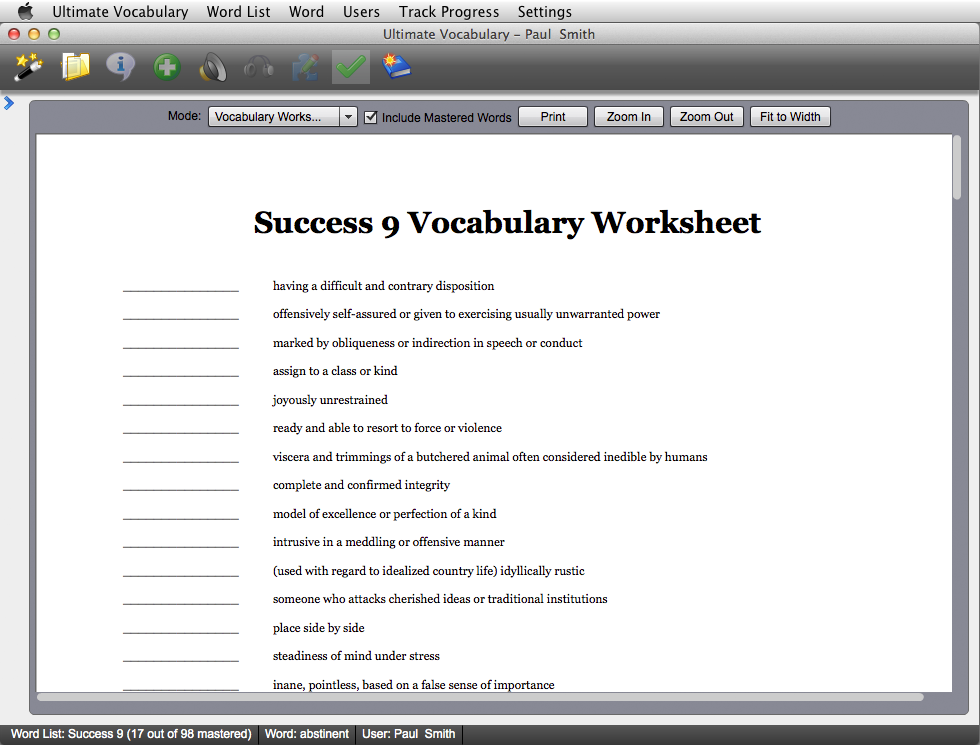
Print Worksheets


Print Worksheets

Print thousands of worksheets and flash cards from any list – even your own custom list.

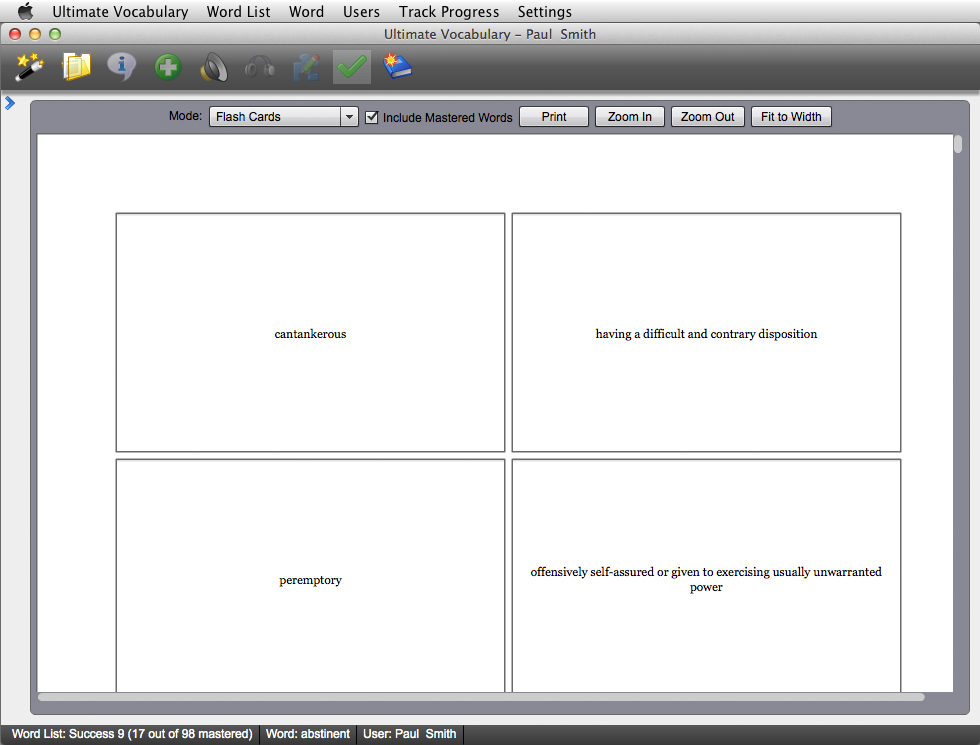
Print Flash Cards


Print Flash Cards

Print high quality flash cards. You can easily make multiple copies of any printout.

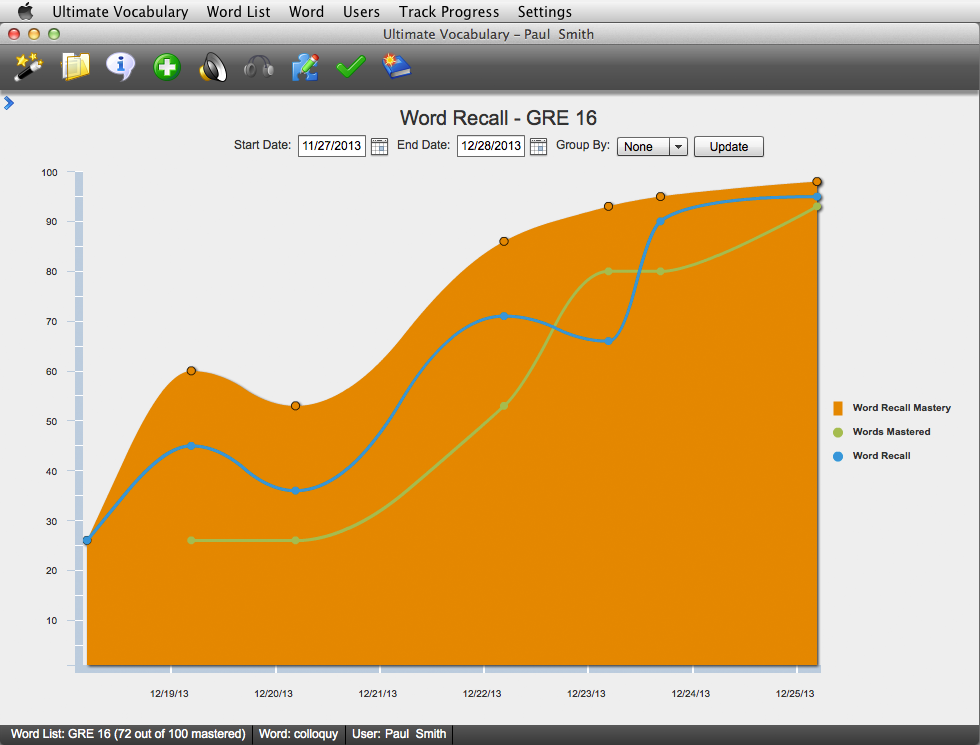
Advanced Tracking


Advanced Tracking

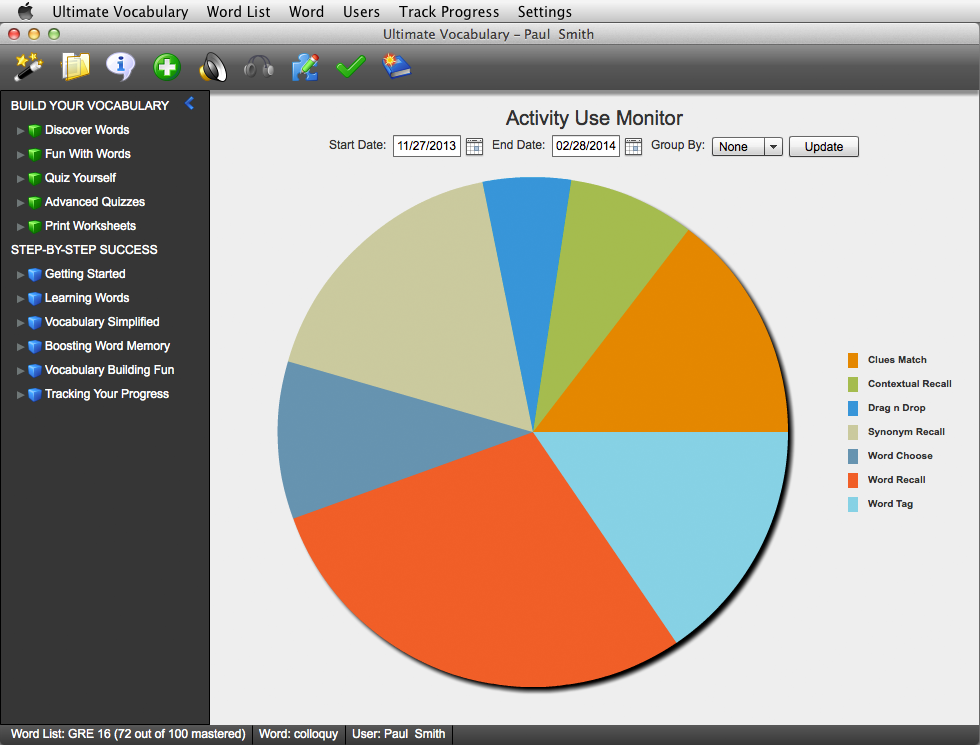
Ultimate Vocabulary uses cutting-edge technology to track your progress and adapt each exercise to your individual needs. Any time you do anything in Ultimate Vocabulary, the software tracks your activity. Ultimate Vocabulary then uses this information to customize your learning for maximum results. Not only will you learn faster, you’ll also be motivated as you see yourself improving.

Customized Learning


Customized Learning

Ultimate Vocabulary automatically customizes your learning to help you improve faster.