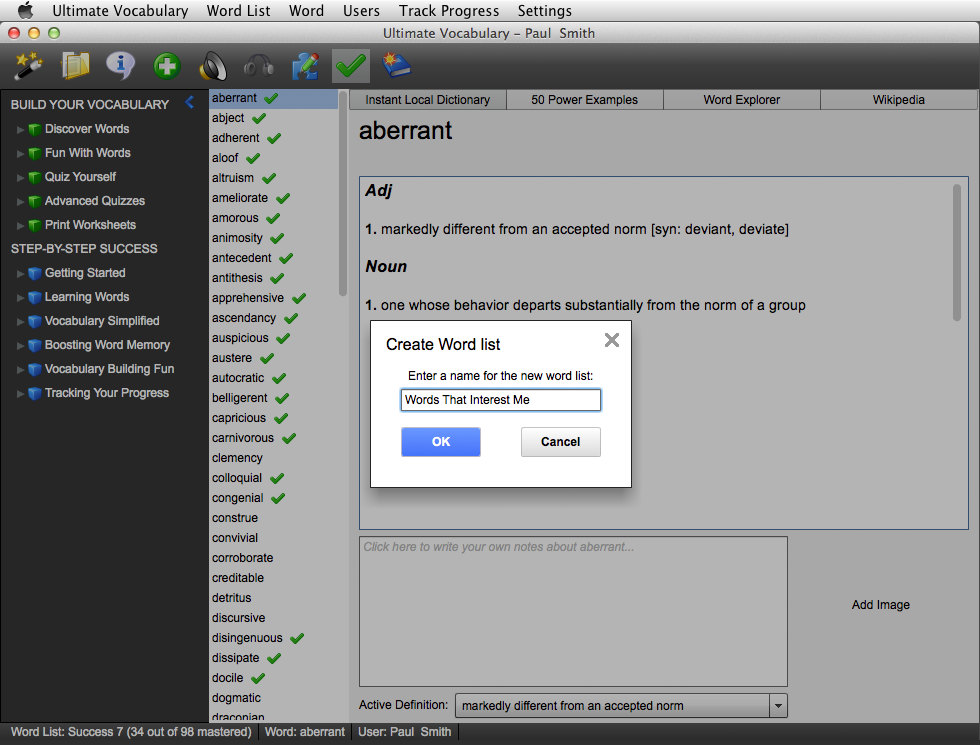
Make Your Own Word Lists
Make your own lists using any words you want to learn. Then let all of Ultimate Vocabulary’s activities, word databases, games, and tracking automatically go to work to teach you the words on your lists.

"Give them the gift of words"
Ultimate Vocabulary EDU is the world's most advanced vocabulary learning system for schools. With Ultimate Vocabulary, you have your vocabulary teaching requirements completely under control.
Based on proven principles of cognitive science, Ultimate Vocabulary EDU contains all the features of Ultimate Vocabulary plus:
It's absolutely essential your students graduate with their vocabulary educational requirements met. With Ultimate Vocabulary EDU these vocabulary requirements are more than met. Students also improve academic performance, are prepared for standardized tests, and improve their confidence.
The next step is to see Ultimate Vocabulary for yourself. Simply fill out the form and we'll send you a free no obligation trial of the full version of Ultimate Vocabulary EDU.


Make your own lists using any words you want to learn. Then let all of Ultimate Vocabulary’s activities, word databases, games, and tracking automatically go to work to teach you the words on your lists.
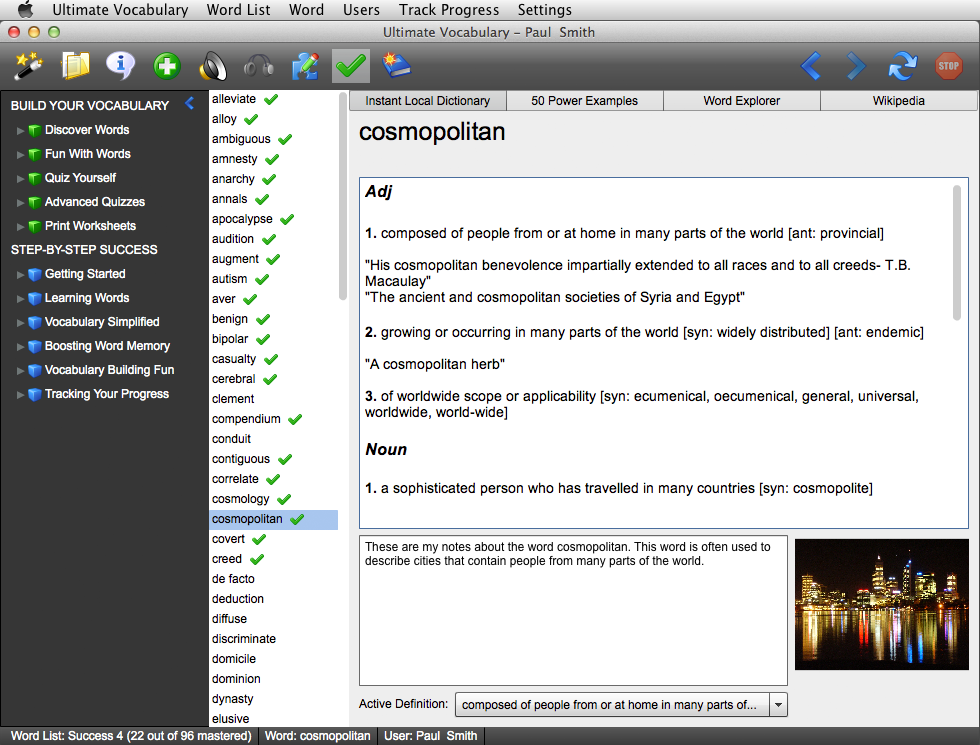
Ultimate Vocabulary includes a powerful word database that goes far beyond a normal dictionary. Access 50 usage examples, visual information, Wikipedia entries, and much more.
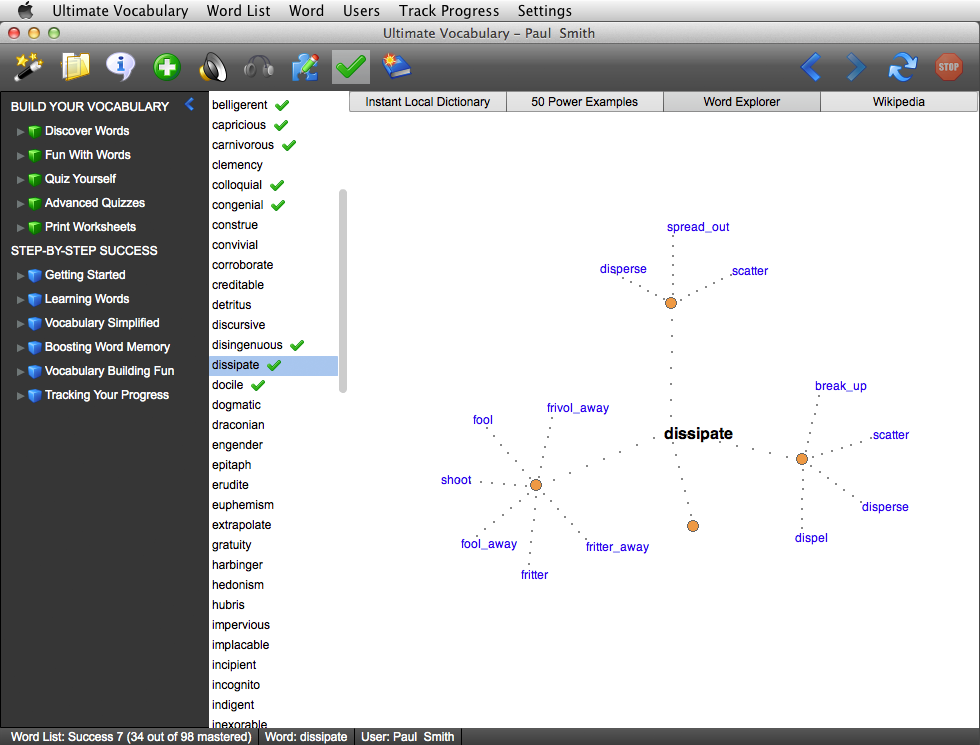
With Ultimate Vocabulary, you can see your words come alive!
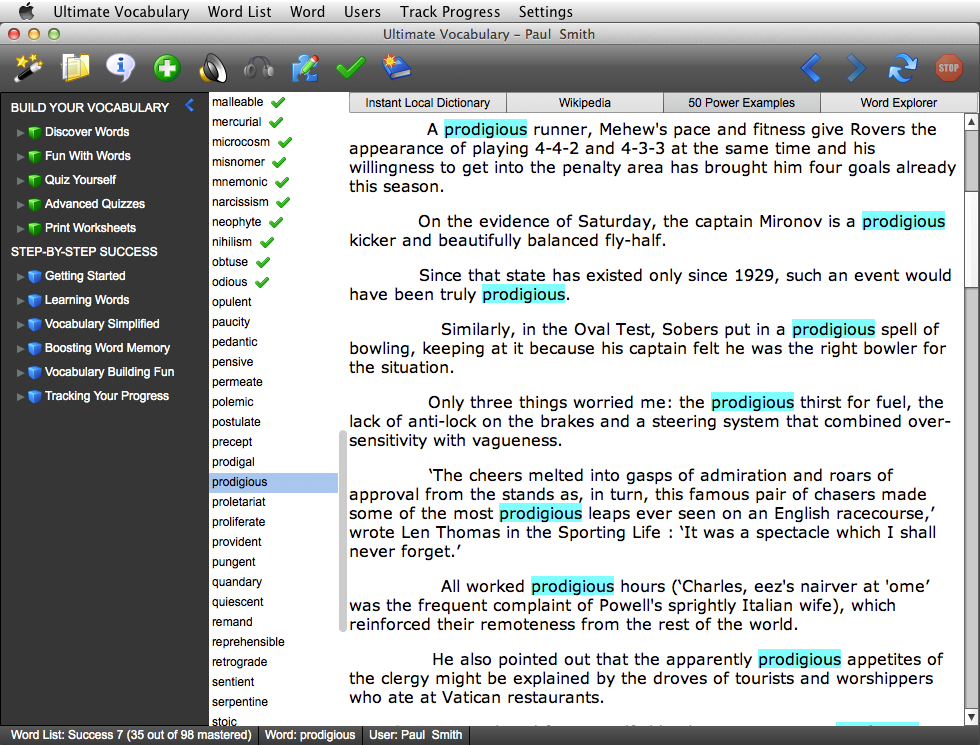
Use the proven principles of elaboration and depth of processing to ensure you’re confident in using new words, and that you remember them forever.
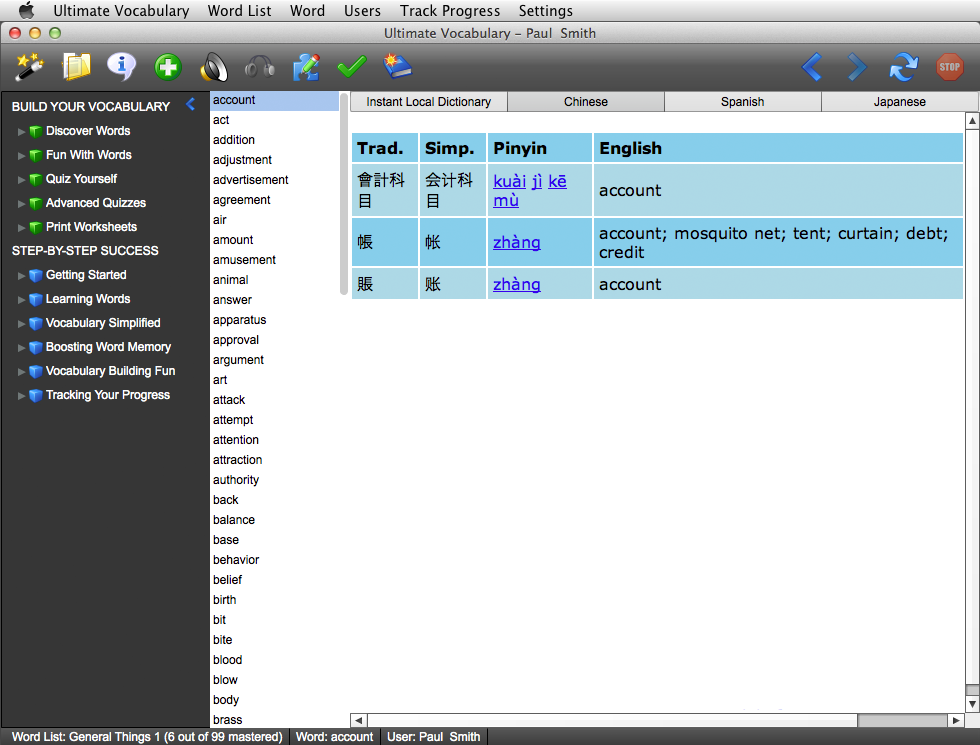
Ultimate Vocabulary can even give you help and translations in virtually any language.
When you write something, whether it’s a letter to a friend, a presentation to your boss, or a paper for your university course, you want it to be memorable. What’s more, you want it to be memorable for the right reasons: quality, clarity, interest, and impact. There are several things that you can do to increase the impact that your writing has, and one of the most important is knowing what words to use. The quality of your writing is closely tied to the vocabulary and phrases you choose, and also to how you arrange those words to communicate your ideas. A well-selected set of phrases can combine to form a message that readers will long remember.
As the American president Abraham Lincoln’s famous “Gettysburg Address” illustrates, it’s not the number of words that counts in the end, but how those words are used. This short speech, given by Lincoln in November of 1863, only consists of 272 words, but it’s still remembered and quoted today. Many people, when they’re trying to write to impress others, think that the more words they use the better. Another common mistake is to believe that using obscure, difficult, and polysyllabic words is the best way to showcase your skills as a writer. While a fancy set of vocabulary words might indeed impress people, it’s much less likely that they’ll walk away remembering the concepts you were trying to communicate.
There’s a time and a place for every word in your vocabulary. Make sure that you choose the words that are the most useful for each circumstance, fitting your words to the listeners or readers, and choosing quality words for their ability to express your ideas rather than overwhelming your audience with quantity alone.
Longer than a Twitter tweet but shorter than many e-mail messages – what would you choose to say in exactly 272 words?
Essential GRE Words is a video lesson series specifically designed to help you boost your GRE score. This is the fastest and easiest way to improve your GRE score – because you are learning the words that appear most frequently on the GRE Exam.
Includes definitions, synonym/antonyms, and examples all sourced from the Ultimate Vocabulary software.
The English language has a long and colorful history, and both the form and the sound of the words have changed over time. If you could time-travel back to the 10th century to hear one of the poets traveling around northern England, reciting long epic tales by the firelight at a hearth in a stone-walled castle, you wouldn’t understand a word the poet said. Even jumping forward a few centuries to Chaucer’s time wouldn’t help if you were listening to a verse from his Canterbury Tales, although if you could have found a rare written copy of the work, it might have been easier. At that time, the language was closer to Modern English in appearance, though still quite different in its pronunciation.
By the end of the 16th century, the essential form of English words was fairly stable, so students reading Shakespeare’s plays in school today don’t have much of a problem. However, anyone going to the theatre to see and hear a play isn’t getting the same experience that audiences 400 years ago had, because a lot of the “word play” that Shakespeare was so good at has been lost with changes in pronunciation. This means that puns and jokes based on the sound of a word aren’t in the text any more, not because the actors forget their lines, but because of the way they say those lines.
While it’s hard to truly know what English sounded like so many centuries ago (after all, YouTube certainly wasn’t around in Elizabethan England!) it is still possible for scholars and historians to make fairly accurate reproductions of the sounds of spoken English from Shakespeare’s day. If you’d like to hear about what one pair of researchers (one a linguist, the other an actor) have come up with, click here to see a video of what Shakespeare’s plays really sounded like.
Most public school teachers arrive at their job knowing that they’ve got a preselected list of lessons and books to work with, and a district-developed set of tests and curricula that they will be using throughout the year to teach their students. When you’re a homeschooling parent, it’s often a little harder to find the right tools to teach your children. That’s why websites like Cristina Grau’s AHomeschoolMom.com are so useful for first-time and long-time homeschoolers – she’s living the process and has valuable tips to share with other parents.
UV: It seems like with four children to homeschool, you’ve got more than enough to keep you busy, and yet you decided to set up this website a few years ago. How do you find time to do everything?
CG: Before taking on anything new, I think a great deal of prayer is necessary. I want to make sure that any new adventure I wish to embark on is not of my own doing, but that my family is behind my endeavors and God is a part of the plan. Once those requirements are in the clear, the next is to organize my time. Blogging is last on my list of priorities, honestly. My family, our homeschooling, and other ministries come first. So, if I plan to add blogging to my list of activities, I need to schedule time into my routine. This is simply done by figuring how much time it takes to handle our learning, then by adding in our chore time, and finding what remaining time is left between the end of lessons and dinner time. I generally schedule a post for the following day so as to remove any stress of having to rush to a computer and get today’s post up and running for people to see. I will often post for several days as well; this helps me manage those extra busy days when blogging would otherwise be impossible. If I had to boil it down to one simple formula, I would have to say a lot of organization and planning ahead.
UV: One section of the website is devoted to books and resources, and we’re grateful that you’ve added our Ultimate Typing software to your list! How do you decide which books and resources to feature in this category?
CG: Any items on the HM Bookshelf are tried and true. If we don’t use them on a regular basis or if they didn’t meet our needs, I do not feel comfortable sharing with other families. I want to pass on information which is reliable and honest. If they worked for us, they just might work for you.
UV: In a post you wrote back in February, you mentioned that you encourage your children to look up words and look for ways to use them in conversation. What other ways can parents help their children improve vocabulary skills?
CG: There are various ways by which we can help our children increase their vocabulary. Reading is the easiest and most beneficial way to make this happen. Don’t be afraid to get outside the picture book section of your library and start adding more challenging reads. While they might struggle at first, they will catch on quickly and be proud of their accomplishments. Besides reading, there are lovely games like Boggle, Scrabble, and more which can increase their vocabulary. Play along with your children and purposefully use words which they are unfamiliar with. This will, hopefully, prompt questions about your words and encourage their use in the future. Balderdash is another exciting way to increase vocabulary. Grab your handy dictionary, pick a word, and let your children help you decide what the “real” meaning of the word is. Through creativity, learning vocabulary will not only be a breeze, but loads of fun!
UV: The “Homeschooling 101″ series is a great introduction for people who are new to the process and need an overview of what they can expect over the next ten to twelve years. What advice do you have for people who have been homeschooling for several years already, and might be losing some of their early energy and enthusiasm for the task?
CG: I think all of us have moments of “burn out”. I think the key is in remembering these are moments. Being tired today, does not mean we need to give up entirely; it means we need a moment to breathe. The best advice I could give is to take those moments! We are not living on someone else’s schedule or routine, we are not machines which need to function at a certain capacity. If you need a break, take one. I have read that some homeschool nine weeks on, one week off; this seems to alleviate stress and keeps everyone focused on the coming break. Others simply take a day off whenever they find it necessary; there is more than enough time in the year to finish learning, one day off won’t hurt. Find a routine that works for you and implement it.
If you are finding the work itself is becoming bothersome, switch things up! Do not become a slave to curriculum. Books are there to work for you, not to be filled by unwilling slaves. Pick a different method or resource to learn by; try something completely different from your normal routine. Change things up! Sometimes we just need to step outside the box and learn by new means in order to reinvigorate our love of learning and keep the flame alive.
UV: You talk about co-op sessions with other homeschooling parents, where several families get together for classes and activities. What are the advantages of working in larger groups like this, rather than always staying at home with your own children and your own specific course of study?
CG: I love being at home with my kids. I get to work out my own routine, take breaks when I wish, and spend one-on-one time with my kiddos. Every once in a while though, we feel the need to step outside our walls and see what the outside world has to offer. Being a part of a larger homeschooling community allows us the security of meeting with like minded people who will encourage our love of learning, come alongside our goals, and infuse us with new ideas. Co-op, and other such venues, allow our children exposure to areas of learning I might not have considered; broadening our scope and planting seeds of thought for future areas of study. Our children are able to socialize with people of all different ages, not just their own, helping them become well-rounded individuals. Parents are able to use this time to observe their children’s interests, their ability to work with others, their character, and share ideas regarding issues which might be of concern or value. No matter how it is accomplished, either through a formal registry or just visiting with friends, being a part of a larger community has something to offer everyone. If nothing else, we need no longer feel alone.
Cross-posted at the Ultimate Typing blog.
A generation (or “familial generation”) is about 25-30 years long on average. In other words, that’s the time it takes for a child to be born, grow up, and have a child of their own, who will be part of the following generation. A hundred years ago, when many people had children much earlier in life, generations were only separated by 15-20 years. It wasn’t uncommon to have family gatherings where the newest baby would sit happily in her great-great-grandmother’s lap as five generations of relatives shared a holiday feast together.
As the length of a human generation gets longer, that of English vocabulary gets shorter. New words are being born every day, and many of them have the potential to make a grandchild’s conversations confusing to their grandfather – the English of fifty years ago is in some ways nothing like the English of today. In fact, some parents have a hard time keeping up with their kids’ chatter! The pace of modern life is getting faster, and we’re creating vocabulary just as fast. Here are some examples of words you might have had to explain to your (grand)parents lately:
locavore noun
Technology and modern industry have contributed a lot of new words to the English language, along with the gizmos and gadgets that keep us connected and entertained, but there are new movements to get back to the time when things were a little simpler and closer to nature. Many people are planting home gardens and raising chickens in their back yards, do-it-yourself beer brewing and bread baking is back in fashion, and the locavore movement is going strong. A combination of the words “local” and the Latin root word vorare (“to devour” – as in carnivore and voracious), this word defines people who try to eat only food raised or grown where they live. Generally, “local” is defined as “within a 100-mile radius.”
upcycle verb
When you take something that other people would, or have, thrown out, and you make something new out of it, you’ve added value by upcycling that item. Some good examples of this trend include using lumber and scrap metal from old boats to make wooden tables and chairs, creating chandeliers out of empty wine bottles, or using broken bits of china to make mosaic tiles for a garden space or indoor room.
muggle noun
Shakespeare is credited with inventing many words that are now part of the English language, and today’s authors continue to add to the richness of the language. One of the newest is muggle – and we’re pretty sure you already know the definition of this word. The Muggles in J. K. Rowling’s world of Harry Potter are the nonmagical people, the ordinary humans who not only can’t perform magic, they often don’t even believe it exists. In current use, it’s someone who doesn’t know how to do something that the rest of the group does.
Check out more new words here – and then go share them with your parents!