"Give them the gift of words"

Ultimate Vocabulary EDU is the world's most advanced vocabulary learning system for schools. With Ultimate Vocabulary, you have your vocabulary teaching requirements completely under control.

Based on proven principles of cognitive science, Ultimate Vocabulary EDU contains all the features of Ultimate Vocabulary plus:

It's absolutely essential your students graduate with their vocabulary educational requirements met. With Ultimate Vocabulary EDU these vocabulary requirements are more than met. Students also improve academic performance, are prepared for standardized tests, and improve their confidence.

The next step is to see Ultimate Vocabulary for yourself. Simply fill out the form and we'll send you a free no obligation trial of the full version of Ultimate Vocabulary EDU.

The 7 Best Ways To Improve Your Vocabulary


Do you remember when you first learned how to speak English? If you were born in an English-speaking country, you’ll find that question hard to answer. After all, you started to learn English vocabulary as soon as you were old enough to hear the voices of people around you. But did you know that you can use the same techniques of natural learning to keep improving your English skills? It’s true! Even as an adult, you can take advantage of these 7 effective vocabulary-building strategies that use your brain’s natural power to improve your vocabulary every day. Here’s how:

Vocabulary Improvement Strategy #1: Listen, look, and learn.


Children are always exploring, asking questions, and watching the world around them. That’s the way they learn – and that’s how you can learn, too. Keep your eyes and ears open for new vocabulary words as you go through your daily routine. By staying alert for new words, you’ll be able to add those words to your vocabulary every day. If you don’t think you’re coming across enough new words each day on your own, try getting some support from vocabulary-building software. Ultimate Vocabulary has a database of over 140,000 words to choose from, so you’ll always find new words to learn. The software also helps you review those new words using another toddler’s trick: repetition.

Vocabulary Improvement Strategy #2: Repeat new words.



Every parent knows the sound of a young child repeating one new vocabulary word over and over again! It’s often frustrating for the parent, but it’s how the child learns that word and makes it a permanent part of their vocabulary. You can use Ultimate Vocabulary’s built-in Word Messenger to help you repeat each new vocabulary word multiple times per day. By the end of the day, you’ve memorized that word, and you’ll even find yourself using it in conversation.

Vocabulary Improvement Strategy #3: Use new words.



Once a child knows a word they immediately start using it, and that’s what you need to do as well. Find ways to include the word in appropriate e-mail messages and conversations. If you’re not sure how to use the word correctly in context, look for examples of sentences using the word. Ultimate Vocabulary gives you one-click access to dozens of usage examples for each new word so that you can be confident you’re using it in the right way, at the right time.

Vocabulary Improvement Strategy #4: Make words your own.


A child has a natural tendency to grab for a new toy and say “Mine!” In the same way, you need to grab on to each new word and make it part of your collection of vocabulary. The best way to do that is to personalize the word by finding ways to fit it into your world. Does the word describe you, or something in your house? Can you link it to another word you already know? Create a mental connection between words by using Ultimate Vocabulary’s Word Explorer feature to find synonyms, antonyms, and other related words. The more links you create, the easier it is to remember a new word.

Vocabulary Improvement Strategy #5: Have fun with your words.



The word “playful” is often used along with the word “child,” and there’s a good reason for that. Children learn through play, and making learning fun will keep them interested in studying. You can add fun to your vocabulary improvement program by playing word games, doing crossword puzzles, or even making up rhymes and songs about vocabulary words. If you’re using Ultimate Vocabulary you’ll have access to lots of fun games that quiz you on your target word list while you’re playing.

Vocabulary Improvement Strategy #6: Use what works for you.
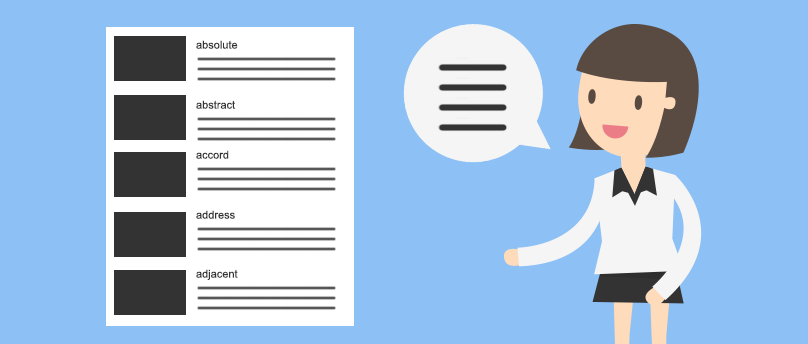


One of the reasons that games are a great learning tool is because they use images, sounds, and physical movement to provide instruction and review. If you learn best when you’re associating a word with a picture, then come up with an image for each new vocabulary word. If you learn words more quickly by repeating them out loud instead of writing them down, make sure that’s part of your vocabulary improvement program. Ultimate Vocabulary helps you do both of these by making it easy to add images to your vocabulary words, and by providing audio pronunciation of many words in its 142,000-word database.

Vocabulary Improvement Strategy #7: Stay focused.
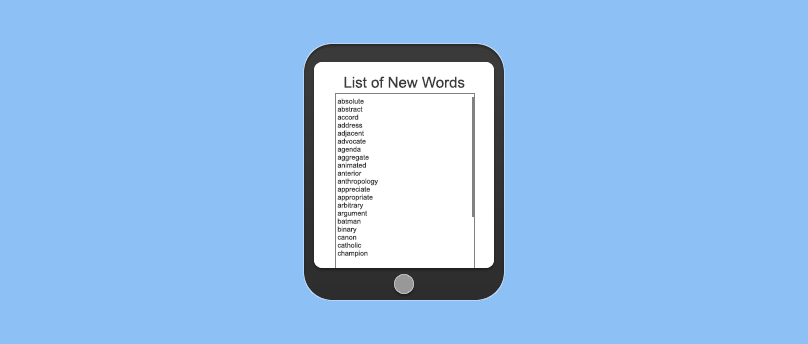


When a child goes to school, they’re given vocabulary words to learn, which increases the number of words they learn each day. You’ll find that making lists of words speeds up your own learning process. Start writing down the words you come across, and use them as a list you can review. This is easy to do with a program like Ultimate Vocabulary, which lets you create as many custom lists as you want. There are also hundreds of ready-made lists that help you learn words for general conversation, grade-specific vocabulary testing, or exams like the SAT and GRE.

Click here to learn more about Ultimate Vocabulary

The 7 Best Ways To Improve Your Vocabulary

She’s The Last Person Left Who Knows Her Language, But She Sure Won’t Let it Die


You might want to hear her story. Fighting for the language that she grew up learning and loving.

Fun Vocabulary Games You Must Play On Ultimate Vocabulary™ 2015


Ultimate Vocabulary™ 2015 is the most recent (and admittedly most fun) version of the vocabulary building software. Apart from frequently-praised features like being cloud-based and enabled for social media sharing, Ultimate Vocabulary™ has another appeal: it comes packed with fun, addictive games.

By playing only a couple of games per day, you will find yourself mastering your new vocabulary without much effort, and having heaps of fun at the same time. Technology’s great, isn’t it?

Crazy Clues

CrazyClues_Game5.1

How well do you know your vocabulary? Crazy Clues is an addictive vocabulary game you won’t get enough of. The game offers a few letter clues for each word, but then you have to figure out the whole word. If you get stuck, don’t worry, because you can get a hint to get your brain going again!

This is the perfect game to brush up on new words you’ve mastered by emphasizing their spelling.

Crossword

Crossword_Game7.1

An interactive word game you will want to play time and time again. Clicking on a empty square will give you a hint for the word across and down the puzzle. As far as this game is concerned, you’re as good as your word definition knowledge!

Unscramble

Unscramble_Game6.1

How fast can you spot a word that’s all scrambled up? Find out with Unscramble, a fun vocabulary game that’s bound to be your next favorite vocabulary game. The faster you figure out the word, the more hints you earn for subsequent rounds. The game offers you a bit of help by giving you the word’s definition.

Word Finder

WordFinder_Game8.1

Another compelling vocabulary game, Word Finder dares you to identify a list of words in a matrix of letters. The words can be aligned vertically, horizontally, backwards and forwards. Let the word hunt begin!

Flash Cards

Another classic vocabulary-boosting game, Flash Cards help you truly get a word’s meaning through repetition and with its definition as your only clue. You can adjust the speed to make the game more challenging!

Hangman

Hangman_Game9.1

A new take on another classic word game, Hangman lets you guess the right word by only giving you the word’s definition. You have ten shots per word before your poor man is hanged.

Word Recall

WordRecall_Game10.1

A classic vocabulary game that will help you improve your vocabulary retention is Word Recall. Read the word’s definition and choose the correct word from the list.

Spelling Drill

SpellingDrill_Game11.1

You never truly master a word until you know how to spell it. Make sure you are the orthography master with Spelling Drill, a fascinating game that urges you to pay attention to word orthography for more balanced and complete vocabulary knowledge.

Vocab Match

VocabMatch_Game3.2

This is a challenging but very amusing game. You must match the right definition with the right word to win the round. You have six different words to get right per round.

Vocab Memory

VocabMemory_Game4.1

If you think memory has nothing to do with vocabulary knowledge, think again. Vocab Match tests your vocabulary recalling power by letting you see a word under one card, then challenges you to find the matching definition under another card – hopefully, before you forget that word’s meaning!


Have something to add to this story? Share it in the comments
 

Why You Should Learn A Second Language


Yes, you can usually get along just fine in life even if the only language you know is English. However, scientists are now confirming that bilingualism has a wide range of benefits – and that these benefits are not just related to communication skills.

Quality Job Prospects

Knowing an in-demand second language like French, German, Spanish, or Mandarin will give you a wide range of better job prospects to choose from. If you’re not from an English-speaking country and English is not your native language, it’s a good idea to choose that language first, as it’s widely used in many global corporations.

You can work at a multinational company and relocate at a moment’s notice to idyllic, exotic urban cities in Japan and Singapore or the West Coast in the US (depending where you’re coming from).

Bilingual employees are often preferred over workers with more technical skills, simply because they already have an advantage: they can instantly communicate and focus on implementing marketing strategies overseas without any linguistic barriers. In general, it’s quicker and easier to learn new technical skills that it is to learn a new language.

Stronger Memory

A less cited benefit of being bilingual is the strong, fit memory you get to enjoy. Since learning a new language mainly consists of memorizing spelling, vocabulary and syntax rules, it helps people improve their memory capacity and flexibility. A university of Brunswick, Canada study showed that bilingual individuals are better at remembering shopping lists and directions than monolingual people.

Shield Against Alzheimer’s and Dementia

study on the importance of bilingualism confirms that people speaking regularly in a language other than their native language tend to experience the first cognitive decline symptoms associated with dementia about 4-5 years later than people who are monolingual. The mean age for dementia’s first signs for monolingual people is 71.4 while for bilingual individuals the average onset is at 75.5 years.

Improved Brain Functionality

When we learn a second language our brain is forced to process, adapt, and use different communication systems. This brain flexibility and adaptability are competencies you can apply in several problem-solving contexts even if they have nothing to do with language use.

Multitasking and Brain Agility

If you’ve ever talked with a bilingual person or are one yourself, you know that the switch between languages — sometimes within the same sentence – is ongoing. Using languages of different structures, vocabulary, and pronunciation rules shows that a person is skillful in both and agile enough to seamlessly juggle them at a moment’s notice.

Knowing a second language will come in handy when you travel abroad, and it does make you look more skilled and professional when listed in your resume, but the mental benefits of being bilingual have long-term advantages that go above and beyond these daily uses.

From a stronger brain and better thinking agility, to improving your conversational adeptness in your native tongue, it is evident that being a polyglot should be the norm.


Have something to add to this story? Share it in the comments

WriteToTop’s Experienced ESL Teacher, Adam, Aims To Teach ESL Learners The Skills Needed For A Clear, Persuasive, and Compelling English Text


Adam


INTRODUCTION: English classes often focus only on the basics of vocabulary, spelling, and grammar. ESL courses cover language basics, but many then spend their time on teaching students how to hold a conversation, order a pizza, or answer the telephone. While these are all necessary skills for anyone who wants to speak English as a native, many classes don’t always take the next step: teaching students to write fluently, as well as to speak fluently. Experienced ESL teacher Adam recognized this lack and decided to set up a new video training series at WriteToTop to help ESL and native speakers alike learn to write clear, persuasive, and compelling English text.

UV: As a longtime professional editor, you’ve probably seen every mistake possible. What types of errors do most people need to learn to avoid making?

While most people might expect me to point out certain grammatical errors as common issues, these can easily be learned or reviewed, and thus avoided. The most common problem that writers need to focus on is their awareness of their readers. One of the first things I remind writers of is the fact that they are not writing for themselves—they are writing something for someone else to read, on their own. Unlike a conversation, where misunderstandings and language issues can be cleared up instantly, a person looking at a text does not have the writer standing next to him or her to clarify a word choice, or an incomplete sentence, or a disjointed argument. So writers need to approach their text with an eye to clarity, concision, flow, and of course a grasp of language rules. Moreover, these problems are manifested in two ways: first, many writers take shortcuts, assuming a reader can make the connections and jumps that are obvious to themselves. Do not make these assumptions about your reader. A good rule of thumb is to consider that your reader is an intelligent person who is literate, but who knows nothing about your subject, so spoon-feed them everything. Second, written language does not tolerate the informalities and the grammatical rule bending and breaking of spoken language. In other words, do not write in the same way as you speak. Again, you are not present with the reader and therefore cannot compensate for shortcuts with facial and body gestures, tone of voice, or other cues.

UV: How does your experience as an ESL tutor influence the way you work with writers?

I had taught ESL for almost fifteen years, in four countries. The first thing I learned as a teacher was that every student is different and cannot be lumped into a “type” of learner. The same applies to writers. There is a whole history behind each person, a culture, a native language, and of course a personality. Teachers and editors need to take these things into consideration. I have found that both English students and writers tend to be very sensitive about their communicative abilities. In fact, one of the hazards of being an editor is showing someone all the corrections made on their text. Students and writers alike hate seeing red on their text. They sometimes seem to take it as a personal affront. This is where my teaching experience has benefited me; I learned how to point out errors in a way that doesn’t offend, such as by highlighting strengths at the same time, or by asking for an explanation in such a way that the student or writer notices the error on his own and makes the necessary adjustments. In terms of editing, I also ask for confirmation on major changes so as to involve the writer in the process. I add a comment in the margins, asking, “is this OK?”, or explaining why I made the change and asking the writer for feedback on the change. When a writer or student feels that the final draft is still his or hers, they are more confident about their writing and want to continue improving.

UV: Your website provides lessons in grammatical structures like independent clauses, and on topics like the use of the subjunctive. Aren’t these taught as part of basic English and ESL classes already?

Yes, they are, but generally these topics are dealt with in a “light” way. Most ESL classes focus on speaking and listening skills. Even when it comes to writing, formal academic writing is often a class on its own. The reason for this is that when it comes to spoken language, much of the communication is delivered in terms of tone, gestures, question-answer cues, and so on. In other words, a person doesn’t have to have perfect grammar in order to communicate an idea. In written communication, on the other hand, even one wrong preposition can alter the meaning of an entire sentence, and unlike spoken English, the person trying to convey a message isn’t usually there to make instant corrections or find alternative ways to express a thought. That’s why on my site I focus on the essential elements of grammar that will make a piece of writing strong, clear, and whenever possible, interesting. I also don’t have much in the way of too-basic grammar on the site. If a writer isn’t aware of verb tense rules, or article usage, then he or she might need to work on their basic language skills a little more before they tackle academic writing. The grammar I include is essential for good writing, and though many students have already learned it, I present it in a way that, hopefully, will make them understand why it’s so important to fully grasp these elements that they could approach “lightly” in their ESL classes.

UV: Another area you cover is how to structure and organize essays and reports. Why is this an important skill?

The basic function of any written work is to convey ideas such that the reader can follow the train of thought of the writer and reach the conclusions, or retain the information as the writer intended. If a written work is not properly organized, then the reader needs to search for the connections, the relations, the reasons, or whatever else the writing tries to express. Most readers do not have the patience or desire to “mine” a passage for the information they need. If it’s not handed to them on a silver platter, they’ll go find another platter.

UV: You also offer video coaching on English-language evaluation tests like the TOEFL and the IELTS. Is this just overall advice and instruction, or do you provide students one-on-one help with these exams?

I offer students private, personalized coaching sessions via Skype, or at my office in Toronto. I say coaching because I do not want to have “students”, nor should test-takers want a “teacher”. Ultimately, the person who takes one of these tests will do so on his/her own. That’s why I coach them on things like approaches to the test they take will take, good/better study habits, time management skills, and whatever other areas they need to focus on. I set them up to self-study, but to do it in an efficient and effective manner.

Cross-posted on the 7 Speed Reading blog.


Have something to add to this story? Share it in the comments

Better Check Out The New Look Of Ultimate Vocabulary 2015


Ultimate Vocabulary™ is getting a makeover, and it will be ready in time for the new year! eReflect has been revamping Ultimate Vocabulary and providing it with a super user-friendly, sleek appearance and a wide range of new features and capabilities.

A revamped user-friendly interface

eReflect is proud of its user-friendly Ultimate Vocabulary™ interface. Creating educational software for children and adults is a challenge and eReflect has found the recipe for a learning environment that’s user-friendly and fun to practice with. The new Ultimate Vocabulary™ interface is sleek, intuitive, and has all the core practices and features in prominent places on the menu.

Cloud-based

Taking advantage of cloud technologies, Ultimate Vocabulary™ is keeping up with the latest trends in e-learning that call for cloud integration for smoother, more efficient learning.

As a result, the brand new Ultimate Vocabulary™ is cloud-based, which means that you won’t have to download  any bulky files onto your device. You’ll simply enter your access and license details through the cloud and have instant access to all of its features and tools.

Being cloud-based, Ultimate Vocabulary™ 2015 offers users the ability to create their account and access it from anywhere, from the classroom, the office, or their home. Ultimate Vocabulary™ offers its range of features, activities, and games with the convenience of the internet, but without the distracting ads and slow-loading websites. It’s all in the cloud.

Personal profiles

Ultimate Vocabulary™ 2015 takes personal achievement one step further by allowing users to create personal profiles and use these to track their progress, set goals, and earn success points for every practice and game they complete. The addition of personal profiles makes practice a more personal matter as each user can know at any time how much progress they’ve made. You can even share your scores with friends on Facebook.

Collecting success points and sharing scores on Facebook

An exciting new feature in Ultimate Vocabulary is the ability users now have to collect success points for every practice milestone they reach. Every game, activity, or exercise they finish will earn them points. These statistics are shareable on Facebook so that users can show off their learning progress with their friends and loved ones.

Ultimate Vocabulary™ 2015 retains all its well-loved and immensely popular features and tools, and it’s also bringing in compelling new games and activities. With the 2015 version of this vocabulary software, you will never run out of practice material, no matter your age or learning goals.


Have something to add to this story? Share it in the comments


Founder of EngVid.com, Joshua Kostka, Shares His Motivation In Providing Resources for English Language Learning


Joshua Kostka


INTRODUCTION: Idioms, common expressions, words to use in business situations (and words to avoid!), the right way to use negative phrases, and even how to answer the telephone – many of these important language lessons aren’t taught in the classroom. In fact, most of the time the best way to learn these aspects of a language is to live in the country where that language is spoken daily, and where you’ll have to speak it, too. For people learning English as a second language, traveling to an English-speaking country isn’t always an option. Fortunately, there are sites like www.engVid.com, where you can find hundreds of mini-lessons on these tricky aspects of English in free videos taught by English speakers living in Canada, the United States, and Britain. We talked to the website’s founder, Joshua Kostka, about his motivation for providing this useful resource.

UV: You live in Ontario, where about 15% of the population prefers to speak French rather than English – and in neighboring Quebec, French is the official language. Did you have to learn another language when you were growing up? Did you choose to learn a second (or third) language as an adult?

Well, the bilingual aspect of Canada is I think overstated. People in most parts of the US hear and encounter Spanish more often than I do French in Toronto.

Speaking personally, though I was born in Canada, my family left when I was 10, and I lived abroad until returning to Canada in my early 20s. My experience of having to learn another language as an adolescent definitely informs my vision for the site. I know first-hand what it’s like to be a new immigrant, to not understand what people are saying or what’s going on around me. More than anything, I know the feeling of being silenced because of an inability to confidently and correctly express myself in the language. It’s not a good feeling, nor is it healthy, to have words inside you that cannot get out. That’s the reason I ask the teachers to focus quite often on practical speaking skills and soft skills. Most people who try can eventually understand another language, but having the ability to speak that language without hesitation is what puts a person on the same level as his/her native speaker peers.

I’m learning Spanish in my spare time now, but I don’t really think learning English is comparable to learning other languages. Most people learning English as adults have had some amount of English in their lives already. How much varies from place to place, but as the dominant language of the last century at least, English is around. That’s why we can teach English to people in English. Much of the audience understands enough English to get at least the gist of the lessons, even if they don’t yet know even the most basic grammatical structures.

UV: You graduated with an honors degree in English literature. Did your experience with language and literature motivate you to start the engVid site?

Probably not in the way you’re thinking, but you might say so. I had four years at university, during which I could indulge myself in the type of humanities education that I expect won’t be around too much longer. I got a broad base of liberal arts knowledge, and developed the skills to analyze and thus deepen my appreciation of those works of narrative I find moving. None of this is useful though when you’re 25 and trying to figure out a career.

So as many do, I ended up travelling for a bit, backpacking in Asia. I met so many people in India, Laos, Cambodia, and other countries in the region, for whom English was the one thing that could immeasurably improve their lives. For so many of these people, English is what can get them out of the slums, out of abject poverty. For the first time, I understood what a fundamental advantage I had been given by being born in an English-speaking country. At the same time, I saw YouTube, which was just beginning its ascent at the time, as a good tool to use to not only give people educational material to which they wouldn’t otherwise have access, but to give them material that was more useful, more direct, and more practical than what they might get in school, if they were even lucky enough to be taught English in school. My mother had taught English at the corporate level, and ran an ESL business while I was growing up, so I had quite a bit of knowledge about the industry. When I got back to Canada, I worked with her to develop a style of lesson video that would be focused, engaging, and consumable in small segments. It was also important that the format of the lessons be something we could create relatively quickly. No fancy animation or things like that, because I strongly believe that a library of 30 English lesson videos wouldn’t be that useful. 300, though – that’s useful. And when we get to 3000, that’ll be really useful.

UV: The videos on the website cover a wide range of topics related to learning English, including pronunciation guides, business English phrases, and preparation for important exams like the TOEFL (Test of English as a Foreign Language). Although you have a “vocabulary” lesson category as well, isn’t vocabulary the key to learning a language?

In the sense that you can’t learn the language without knowing words, clearly learning vocabulary is the core of learning any language. Our content reflects this – vocabulary is the category in which we’ve produced the most lesson videos, and lessons filed under some of the other categories on the site, like slang or business English, are often just more specialized forms of vocabulary lessons. We provide the categorization on the site for viewer convenience, but the fact is that most lessons involve learning some grammar and usage, some vocabulary, pronunciation dos and don’ts, comprehension in the form of learning how words are actually encountered in real life, and so on. Depending on the viewer’s level of English, he/she might not catch everything or even retain the main lesson taught. It doesn’t matter – they are improving just by watching and listening actively and trying to parse and process everything to the best of their abilities.

UV: Students can use the English Lesson Finder to search for video lessons by difficulty level and topic, and even search for specific teachers. If someone is a first-time visitor to the site, where do you recommend they start?

Something that’s both a strength and a weakness of EngVid is that our lessons are not presented in any given order. Though new users might find this scary, what it actually means is that you can get on the site, watch any of our almost 800 videos, and get a complete lesson. Lessons on vocabulary or expressions are good places to start, because they usually don’t require extensive knowledge of grammar. Sometimes these lessons are really specific, and sometimes they are general, but anyone who wants to improve his/her English can devote 15 minutes to watching one of the lessons, committing the information to memory, and taking the accompanying quiz. I actually recommend that viewers do the quiz the day after they watch the video, to make sure the knowledge has been retained. Over time, all these smaller chunks of knowledge add up to greater proficiency and confidence in using English.

UV: You’re constantly adding new lessons to the site, and you also provide printable documents for offline study. What are your plans for the website in 2015?

The main focus has been, and will continue to be, creating a large library of videos for people to watch. We have around 800 video lessons now, and are currently adding close to 200 new ones per year. In addition to the videos, the site will be growing in several ways. A new teacher will be joining early in the year. Her videos are very clear and are primarily aimed at beginners. We will also be updating our site; the most important addition will be giving users the ability to easily track which videos they’ve watched and to keep a record of their quiz scores.

Our biggest project for 2015, though, is a completely new section of full courses in English, covering large areas from start to finish. In addition to providing a more linear, guided learning path for students, these courses will include more supplementary and reference material than our normal English lessons. So lots to look forward to.

A Real Gentleman Will Say No To Violence. Hear Him Speak and Share It To The World!


Listen to how Carlos Andrés Gómez, actor and poet, choose his words rightly to create a wonder poem called “When”. The poem illustrates the slow progress we’ve done as a community for women’s rights.

Every Kid’s Perception of Their Mom – Very Different To What We Think


Touching video about how children see their mom. Heartwarming, worthy of sharing!

How To Maximize Your Time Playing Indoor Activities


Spring showers ruined your outdoor activities once again? Many parents dread rainy days because there’s not much room for creativity and play. Children easily get bored and distractions get into the way of learning – especially when the initial plan was to play tag in the yard and then go for a swim.

However, indoor activities can help your child learn new things and master essential skills. Indoor time doesn’t necessarily mean online games time. You can use technology in ways that are educational and constructive.

Vocabulary Improvement

Vocabulary is one aspect of language we never truly master. You can learn a new word every day and still have thousands of new words left to learn by the time you’re fifty. Why not invest in a vocabulary improvement software and play vocabulary games to improve the entire family’s vocabulary? People of all ages will benefit from adding new words to their lexicon.

A vocabulary exercise sharpens a child’s language skills and gives them new words and concepts to communicate with.

Spelling Improvement

Your child’s teacher might be doing an excellent job teaching students how to spell, but the true secret to spelling mastery is to learn to love spelling. Half the children in any given class probably hate spelling exercises, and most of the rest are generally indifferent. To get children interested in spelling the activities you engage them in must be fun. Did I say fun? I meant SUPER FUN.

Again, this is where a spelling program or website could come in handy. Create a two-hour spelling session with 3 to 5 brain breaks in between and play spelling games and other fun-based spelling activities like a spelling bee stand-off!

Keyboarding

While most online games don’t really help children learn to type, it’s a good idea to think of touch typing as a fun indoor activity that will entertain and educate at the same time.

Touch typing is crucial for your child’s academic performance this year, and will be needed until they graduate from college – and beyond. As technology becomes more entwined in every aspect of our lives, skills like keyboarding become the norm. The earlier your child learns to touch type the better off they will be.

Use indoor time to engage with a skill your child will benefit from throughout their entire life by helping them enhance their typing skills. The great thing is that keyboarding is one skill you can have a lot of fun with when practicing. In fact, you don’t even have to structure a keyboarding lesson as a lesson. After your child has learned the fundamentals, the entire learning practice can take place through typing games!

Reading Improvement

Reading has been touted as the key ingredient for personal success. Warren Buffet, the well known success maven, has testified to this, asserting that all he does all day is read in his office.

Unfortunately, cultivating a love for reading and learning in children can be a real challenge for teachers and parents. The secret is to make reading fun and effective.

What makes students dislike reading is often their lack of good reading skills. More often than not, they find reading boring because of bad reading habits, such as subvocalization and regression.

If children were to get rid of these reading-sabotaging habits then their reading speed would improve and they could effortlessly get through lots of reading material in less time.

Speed reading is more than the goal, it’s also a means to an end. When a student is a speed reader this further motivates them to study and learn more things. Essentially, a child enters a self-motivating circle of self-education and progress through the simple act of eradicating bad reading habits and improving their reading speed.

Indoor activity time shouldn’t be limited to sterile, uninspiring entertainment and passive pastimes like video games. Technology has spread out into the realm of education, and it is a parent’s duty to instill in their children a predilection for learning and self-development.

There are many online resources available where parents can find constructive, age-appropriate activities for their children. Here are some suggestions:

DiscoveryEducation.com,

PrimaryResources.co.uk

FamilyEducation.com

topmarks.co.uk.

Smarttutor.com

Raz-kids.com

Scholastic for Parents

These free, quality resources for parents will give you many ideas for learning activities and games for children from kindergarten up to 12th grade. For a more focused and structured learning experience on a particular skill, it’s wise to invest in the appropriate software. For instance, if you want to improve your child’s vocabulary you should consider getting a vocabulary program like Ultimate Vocabulary™.

Cross-posted on the Spreeder blog.