"Give them the gift of words"

Ultimate Vocabulary EDU is the world's most advanced vocabulary learning system for schools. With Ultimate Vocabulary, you have your vocabulary teaching requirements completely under control.

Based on proven principles of cognitive science, Ultimate Vocabulary EDU contains all the features of Ultimate Vocabulary plus:

It's absolutely essential your students graduate with their vocabulary educational requirements met. With Ultimate Vocabulary EDU these vocabulary requirements are more than met. Students also improve academic performance, are prepared for standardized tests, and improve their confidence.

The next step is to see Ultimate Vocabulary for yourself. Simply fill out the form and we'll send you a free no obligation trial of the full version of Ultimate Vocabulary EDU.

How Reading Boosts Your Brain Into High Gear


Recent studies using high-tech tools that measure brain activity show that when you read more complicated texts, with words that are unfamiliar or used in unexpected ways, the electrical impulses in your brain increase. In a sense, it’s like a “rocket boost” for your brain, according to Philip Davis, an English professor and one of the team of researchers who are examining this phenomenon at Liverpool University. New vocabulary words set off a spark, so to speak, as your brain tries to “illuminate” the blank space that needs to be filled in with the word’s meaning. Think of the word clarify, which has its origin in the Latin word clarus (“bright, distinct”). The light that goes on in your brain when you solve a puzzle or find an answer to a problem isn’t just metaphorical – there’s actually energy flowing around in this process, just as when electrical power lights up a lamp bulb.

Many studies have also shown that when multiple areas of the brain are active at once, a person’s ability to learn and remember are increased. The Liverpool University project clearly shows that when people read more difficult texts, it stimulates activity in more than one segment of the brain. When your brain is fully awake and active, that’s the best time to learn new vocabulary words. As soon as you come across a word you don’t know, look up its meaning and pronunciation, and spend a few minutes saying it out loud and practicing it. If you can’t do that, jot the word down and look it up as soon as possible. Take advantage of all the energy that’s available to you to focus on adding that word to your working vocabulary, and you’ll find that it’s easier to remember in the future.

What’s more, each new word that you learn and are able to remember will help you increase your reading speed. One of the things that slows down people who want to be speed readers is a lack of vocabulary words. If you have to stop and look words up all the time, you’ll naturally read more slowly. Worse, if you skip over words you don’t know, you might misunderstand the text, and that will cost you even more time as you clear up confusion, or reread the text, or both.

So the next time you’re looking for something to read, make your selection from classical literature, or a work of nonfiction on a topic new to you, or anything else that you know will challenge you with new words, and you’ll soon find that both your vocabulary skills and your speed reading skills will improve.

Cross-posted at the 7 Speed Reading blog.

PWND! Text Speak Takes Over


Online chatters, gaming geekers, cellphone conversationalists, and pretty much anyone under the age of 25 all have one message for people complaining about the destruction of the English language via text speak: KTHXBAI. Rather than being the electronic virus that weakens children’s abilities to learn, read, and spell English words correctly, it’s now seen as more of a dialect of English, or even a second language, one that incorporates symbols as well as letters. While it’s possible that in some cases school papers are turned in with abbreviations found in text messages, rather than properly-spelled English words, as the years go by studies are finding that in general texting has no negative impact on overall literacy.

In fact, as John McWhorter, professor of linguistics at Columbia University, said in a recent talk on the subject, being able to switch between standard English and its more abbreviated form is almost like being bilingual. As many research studies have found, when children are bilingual, they have better overall mental skills. When you look at it in this light, it’s actually a good thing that children – and adults – are using this second “language” to communicate. As McWhorter says, in his experience as a professor, students aren’t handing in test papers filled with words like l8r or 4get or 2day, even though they might be using those abbreviated spellings in the text messages they’re sending out right before they take those tests. This flexibility in language use shows that they’ve got flexible and agile brains, something that will help them academically in any field, not just English.

In addition, he points out, abbreviations and slang have always been part of language, English included. Some words like sonar and AWOL started out as simple acronyms, but are now recognized as standard English words. It’s impossible to say what text speak terms might make it into the OED in the future, but McWhorter and other linguists are now saying that we should look at texting as part of the ongoing evolution of the English language, and not as an aberration that is destroying spelling and vocabulary skills.

You can hear Professor McWhorter’s TED talk on text speak here.

Cross-posted on the Ultimate Spelling blog.

Why You Need More Than Words In Your Vocabulary


You’ve spent hours learning powerful English vocabulary words, and are confident that you know the right words for every situation. You’re a master of description and definition, and your spot-on pronunciation of each word ensures that you’ll always be understood. Or will you? If you only know words but not how to put them together effectively, your communication skills won’t be as good as they could be. Grammar is one important aspect of vocabulary building, because you need to know the right way to assemble words into phrases, and phrases into sentences. You’ll also need a good grasp of proper punctuation, so that your grammatically-correct sentences aren’t just long strings of words. Here’s an overview of basic punctuation marks that will help you clarify and add nuance to your phrasing:

.   The period is used to end a sentence.

,   The comma is used to indicate a pause, or to put a break between phrases to keep their meaning clear. Don’t be afraid to add commas to your sentences – as you can see by the example below, they’re quite useful!

I really like barbecuing my dog and working in my garden.
I really like barbecuing, my dog, and working in my garden.

!   Use an exclamation point to add emphasis!

?   Do you think anyone will forget how to use a question mark?

:   A colon is used before a list, an explanation, or a quote.

;   The semicolon is probably the most misused punctuation mark; it should generally only be used to separate two independent clauses. As you can see from the previous sentence, “independent clause” means each phrase could also stand alone. Semicolons are also sometimes used to separate groups of items in a list following a colon.

There are many other punctuation marks, but they’re much less common. You probably won’t see an interrobang or an asterism in any text you read, though they’re both valid marks. We recently came across an article recommending the creation of new punctuation marks, including the andorpersand and the superellipsis. Who knows? Perhaps in a few years they’ll be a common part of the English language, too.

If you’re really into punctuation marks, mark September 24th on your calendar, and get ready to celebrate National Punctuation Day! And even though punctuation marks are designed for written use, as Victor Borge famously noted, phonetic punctuation might be useful in conversation as well. Add rhythm and interest to your writing and your speech, and learn how punctuation can add value to your vocabulary study.

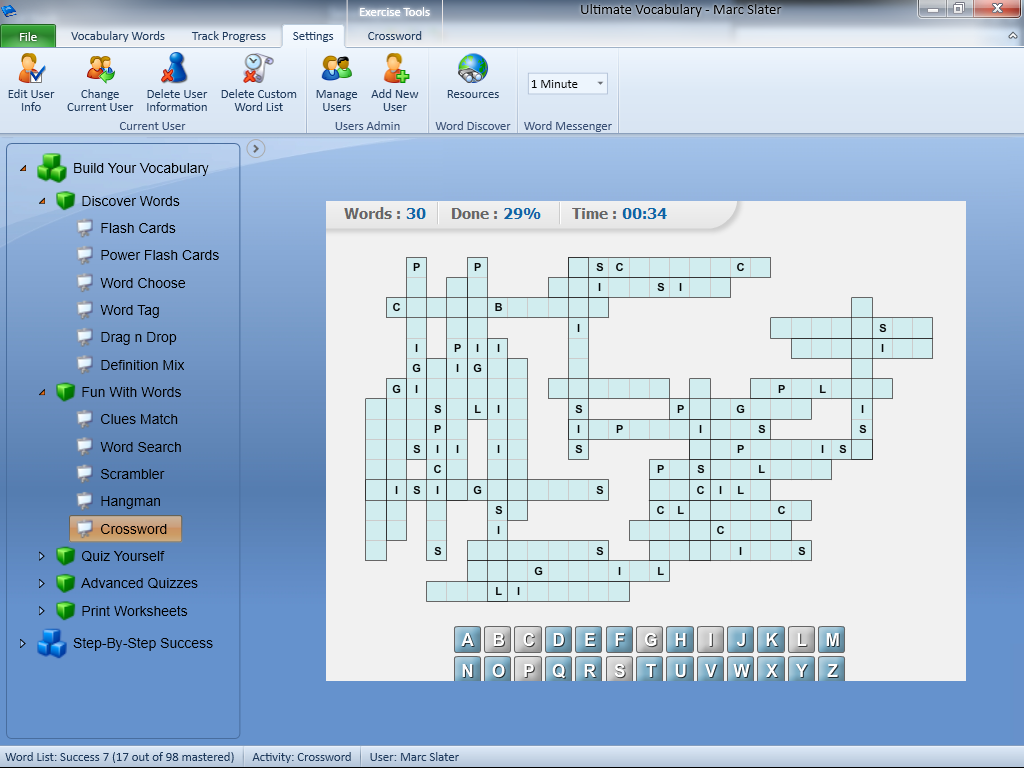
Cool Games


Cool Games

Simply play the fun games for a few minutes each day, and your vocabulary will improve automatically.

Scientifically Designed


Scientifically Designed

The games and activities use scientifically proven learning principles such as depth of processing, elaboration, and spaced repetition. This makes it fun, fast, and easy to improve your vocabulary.

Complete Confidence


Complete Confidence

In addition to being fun, the games give you complete confidence with the words you’re learning. You’ll never be embarrassed about misusing a word again.

Play With Any Word List


Play With Any Word List

You can use all the games and activities to learn any word list – the games even work with your own custom lists!

Motivate Yourself


Motivate Yourself

The games are so fun and addictive that you’ll find yourself looking forward to improving your vocabulary. It’s the most entertaining way to become a powerful communicator and boost your success.

5 Easy Ways to Learn Vocabulary


As we’ve talked about in previous posts, one of the best ways to quickly expand your vocabulary is by looking at a word’s etymology. This does two things: first, it helps you better understand the word, because it makes it easier to understand what the word means when you analyze all the parts of the word. For example, the word root -logy is common in many words, and once you learn that it comes from a Greek word meaning “study, discourse, discussion” you’ll quickly recognize the meaning of all the words containing that root. That leads to the second advantage of including etymology in your vocabulary study: you’ll learn more words more quickly, because you’ll be able to identify the root meanings. Let’s use four words ending with -logy to illustrate this, and to discuss four other easy vocabulary tricks.

Another great way of learning multiple words at once is by looking at a word’s genealogy (Latin genus, or “family, origin”). By exploring all related words you’ll get a complete set that will be easy to learn and remember, for only a little more time and effort than it takes to learn one single word. For example, don’t just learn the word break, but also look at words like unbreakable and breakfast at the same time.

Theology (Greek theos, meaning “god”) is the study of religions, or systems of belief. Sometimes you need to focus on believing in yourself in order to keep your spirits up and continue working towards a goal. That’s especially important with vocabulary building, which can sometimes be frustrating. Keep in mind that you’ll get a lot of self-confidence from having a good vocabulary, and that will give you the confidence now to move forward with your study program.

Because it often seems like there’s never enough time to do anything, sticking with a schedule is very important for good progress in any study routine. Chronology is a word meaning “the order of events as they occur” or “the study of events as they occurred” – the Greek god Chronos was the original “Father Time.” Look at your schedule and make sure there are regular English vocabulary sessions on it. Try to spend at least 15 minutes a day on vocabulary practice.

Above all, don’t forget that exploring to find new words is a great way to keep your interest in vocabulary active. Just like scientists in the field of cosmology (Greek kosmos, “the universe, the order of the world”) point their telescopes into the unknown looking for new galaxies, you can keep your eyes looking outwards to always be ready to discover new vocabulary words. Keep studying!

Personal Help


Personal Help

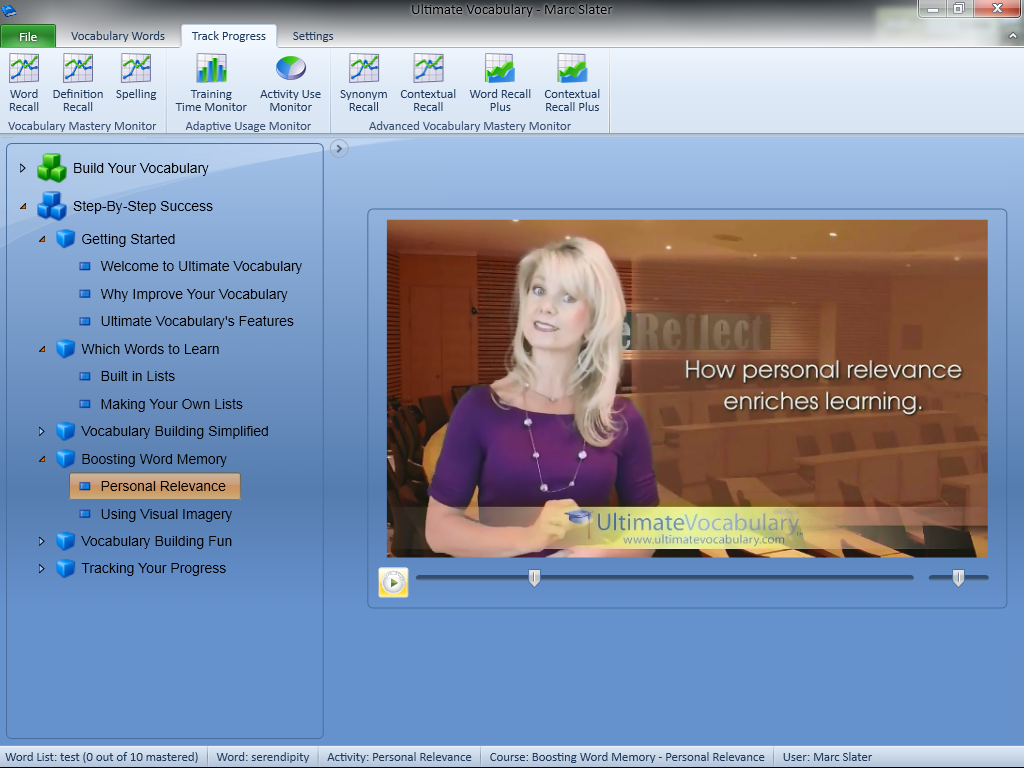
Your personal coach takes you by the hand and helps you at every step. Vocabulary building is now easy for everyone.