"Give them the gift of words"

Ultimate Vocabulary EDU is the world's most advanced vocabulary learning system for schools. With Ultimate Vocabulary, you have your vocabulary teaching requirements completely under control.

Based on proven principles of cognitive science, Ultimate Vocabulary EDU contains all the features of Ultimate Vocabulary plus:

It's absolutely essential your students graduate with their vocabulary educational requirements met. With Ultimate Vocabulary EDU these vocabulary requirements are more than met. Students also improve academic performance, are prepared for standardized tests, and improve their confidence.

The next step is to see Ultimate Vocabulary for yourself. Simply fill out the form and we'll send you a free no obligation trial of the full version of Ultimate Vocabulary EDU.

Advanced Tracking


Advanced Tracking

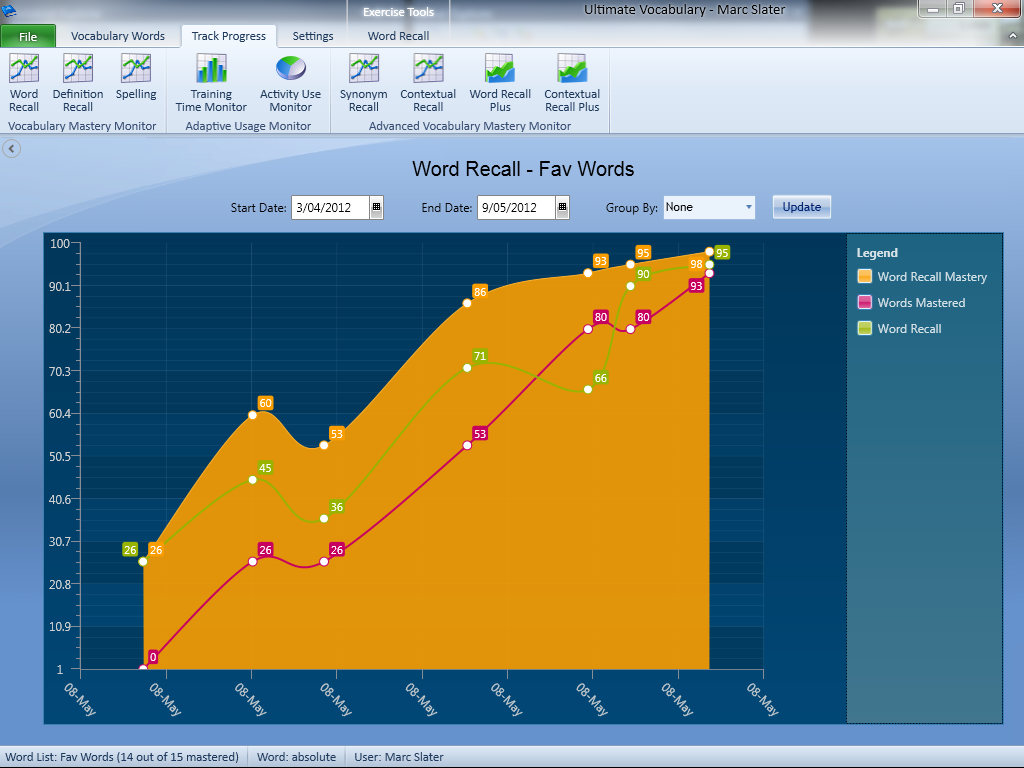
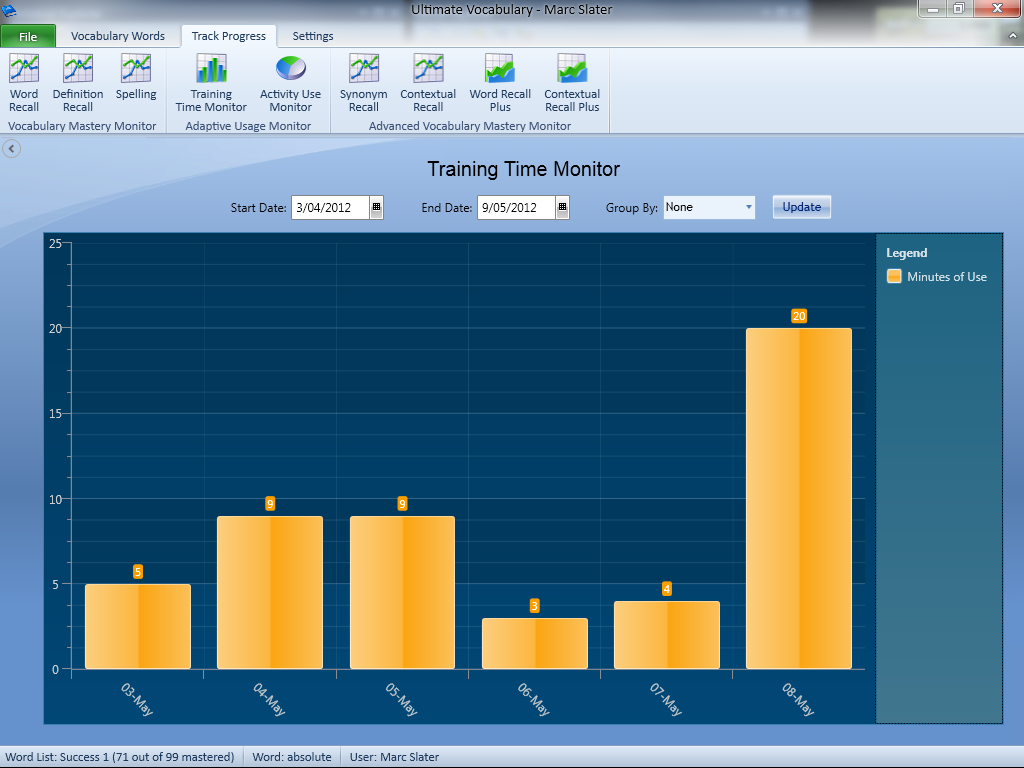
Ultimate Vocabulary uses cutting-edge technology to track your progress and adapt each exercise to your individual needs. Any time you do anything in Ultimate Vocabulary, the software tracks your activity. Ultimate Vocabulary then uses this information to customize your learning for maximum results. Not only will you learn faster, you’ll also be motivated as you see yourself improving.

Customized Learning


Customized Learning

Ultimate Vocabulary automatically customizes your learning to help you improve faster.

See Yourself Improving


See Yourself Improving

See how a few minutes each day translates into a measurable improvement in your vocabulary.

Print Worksheets


Print Worksheets

Print thousands of worksheets and flash cards from any list – even your own custom list.

Print Flash Cards


Print Flash Cards

Print high quality flash cards. You can easily make multiple copies of any printout.

Play Music For Babies And Help Develop Their Vocabulary


You’ve probably heard about the “Baby Mozart” series of CDs that are designed to help soothe cranky toddlers, or the “Baby Bach” videos that combine music and visuals to gently stimulate a young child’s brain using melody and non-verbal images. The company that makes these products, Baby Einstein (now owned by the Disney Corporation), advertises them as being ideal ways to encourage the youngest children to interact with their surroundings, and to guide them into being interested in the world around them. Music is always popular with children, and as childcare site Nannypro notes, including music in playtime keeps children engaged and entertained. Whether it’s singing lullabies to babies or joining a two-year-old in a quick disco dance routine, parents and babysitters have always turned to music at some point.

As a recent study points out, however, music isn’t just for entertainment purposes. Researchers at Rice University’s Shepherd School of Music and the University of Maryland, College Park’s Language and Music Cognition Lab say that for babies, music can also be a way of introducing language. The study notes that even before a child recognizes individual words, they still tune in to the “creative play with sound” that they hear in music, and it’s this musical aspect of language that they’ll focus on first. They are able to heart the tone and timbre (in other words, the various sounds) of the language even when they don’t know the words. As parents, we instinctively turn speech into music when we’re speaking “baby talk” with its exaggerated noises, tones, and rhythms. Other studies have shown that this form of speech – which is higher in pitch, repetitive, and sing-song – is common to “baby talk” across the world in many languages. Babies are aware of this musical aspect of language from the beginning. It’s only later that vocabulary and grammar rules are added that teach them a specific language. Because to children all languages are the same at the beginning, it’s easy for them to learn new languages. Each language is just another “song” they learn to sing.

Because the parts of the brain involved in listening to music are the same as those involved in hearing and using language, adding a musical element to your child’s life will help them learn to distinguish between new words, remember those words, and use them.

Get the link to the full study here and learn more about the connection between music and language development.

Word of the Day: Perseverance


Surveys have shown that only 1 in 5 people actually keep their New Year’s resolutions and accomplish their goals. What’s more, 2 in 5 people give up even trying to keep their resolutions before the end of January! If you’re struggling to stick to your goals of incorporating vocabulary study into your daily routine, it might help you to think about all of the benefits a good vocabulary can bring to your life. You’ll soon see why perseverance, continuing to make an effort in spite of obstacles, pays off.

Vocabulary building can be fun! Today’s word, perseverance, has its roots in the Latin word severus, as does the English word severe. But don’t think that studying words has to be hard or boring – you can build your vocabulary by reading books, by playing word games, and by taking some time to explore the history of a word.

You can learn multiple words at once. When you’ve found one new word for your vocabulary list, you can instantly multiply that by the number of synonyms for the word. For example, synonyms for the word perseverance include dedication, fortitude, resolution, and tenacity.

Vocabulary helps you develop your creativity. An excellent way to make sure you truly know a word and how to use it correctly is to create several sentences using that word. When I finish learning the 25 words on my current list, I will reward my perseverance by treating myself to a good movie and some popcorn.

Vocabulary helps you succeed. Added to the short-term success of accomplishing your daily, weekly, and monthly vocabulary-learning goals, the long-term success that a good vocabulary brings is due to your increased ability to communicate and impress people with your verbal and written skills. Keep that in mind when you feel ready to give up, and persevere with your study program – you won’t regret it.

Slide 3


Slide 3

Help in Other Languages


Help In Other Languages

Ultimate Vocabulary can even give you help and translations in virtually any language.

9 Words NOT To Use In 2013


English is an inventive language, and new words pop up year after year. Some of those words eventually make it into the “official” list of English vocabulary, while others fade away, either because no one is using them any more, or because they’ve been used too much. People who spend their time working with words, like journalists, writers, and editors, usually have strong opinions about the trendy words that may or may not end up as official English. Remember the word bromance, defined as “non-sexual love and affection between two straight males” and sometimes used to describe movies based on that concept? Quite a few “serious” journalists laughed at the term, but in 2010 it was officially adopted into the language and added to the Oxford English Dictionary. It’s hard to tell what words will end up popular enough, for long enough, to become part of the OED.

2012 saw the invention of many new words, and of different ways to use existing words. Will any of them make the leap to official English? That’s hard to say. However, the editors at The Atlantic have a list of words they hope will stay in the past. To start out your new year in words, maybe you should leave some of these old ones behind.

artisanal
Once this adjective meant “made by hand, in small batches, by a single producer” but now you’ll find it on labels for everything from bottled water to factory-produced pizza crusts.

ecosystem
The correct definition is “a biological system of organisms and their environment and how they interact together.” If you’re not a botanist, zoologist, or other life sciences researcher, you might want to avoid this word.

epic
Originally referring to a poem of historical deeds that was often so long that reciting the poem took longer than the deeds it described, this word has been so overused as an adjective that anything described as epic just might not be anything worth writing about.

hashtag
As the name for the # character used in social media, it’s not bad – but please, don’t turn it into a verb!

hipster
Back in the 1990s the word hipster took the 1940s word hip and applied it to a group of (usually) child-free, relatively wealthy adults who were on the cutting edge of trends. However, the word has aged, and not well, and it seems like anyone can be a hipster these days.

literally
When used literally, this word is still useful; for example, “to take something literally” means to understand it exactly as said. However, as an emphatic exclamation, it’s not quite as useful.

organically
According to the editors at The Atlantic, even if you are describing something that arose spontaneously from a series of biological interactions, you probably don’t want to use this word to do so.

ping
Another word that is morphing from computer-speak to regular English, to the editors’ dismay; do we really need another way of saying “contact” or “send a message” via computer or any other medium?

twee
This adjective has been around for quite some time, and it probably won’t go away. Twee means “excessively cute, sweet, or sentimental.”

See the full list of words to avoid in 2013 here.