
193 Built-In Word Lists
Ultimate Vocabulary contains 193 built-in lists created with the input of over 23 world-leading vocabulary experts. Use these lists and immediately get the vocabulary skill you need to succeed.

"Give them the gift of words"
Ultimate Vocabulary EDU is the world's most advanced vocabulary learning system for schools. With Ultimate Vocabulary, you have your vocabulary teaching requirements completely under control.
Based on proven principles of cognitive science, Ultimate Vocabulary EDU contains all the features of Ultimate Vocabulary plus:
It's absolutely essential your students graduate with their vocabulary educational requirements met. With Ultimate Vocabulary EDU these vocabulary requirements are more than met. Students also improve academic performance, are prepared for standardized tests, and improve their confidence.
The next step is to see Ultimate Vocabulary for yourself. Simply fill out the form and we'll send you a free no obligation trial of the full version of Ultimate Vocabulary EDU.


Ultimate Vocabulary contains 193 built-in lists created with the input of over 23 world-leading vocabulary experts. Use these lists and immediately get the vocabulary skill you need to succeed.
In the early days of the United States, the country was often referred to as the “melting pot” where people from many different cultures and languages came together to form a mixture or blend of communities working and living together. The word amalgamation means a mixture, where different parts are melted and fused into one substance. It’s often used to refer to the process of making alloys, such as when copper and zinc are combined to make brass. But unlike the homogeneous metal alloy, the human combination still keeps its individuality, as the different native languages are first preserved and then mixed in with English. Over the centuries, English has added many new words from these immigrants, and become the richer for it.
But there’s still room for more people in the United States, and for more new words in the English language! One word we saw recently deserves to be included: the Portuguese word saudade. It’s a word that packs a lot into three syllables. On the surface, it might be defined as simply meaning “a sense of loss,” but when people use this word, they’re referring to a profound emotional state where love and longing and nostalgia and even regret are felt in an amalgamation of feelings that simply can’t be described in one English word.
In a previous post, we talked about other non-English words that efficiently express complicated concepts and which could be useful additions to the English vocabulary. By learning these words, you’ll learn more about the cultures they came from, and get more familiar with the way people in other countries view the world and how they live in it. If you don’t have time to travel, you can send your vocabulary on a global journey and find new words to blend in to your daily conversations.
What interesting words have you found in other languages?
We’re well into 2013 now, and January is already over! How are you doing with your New Year’s resolution to learn more English vocabulary? If you’re struggling with finding time to learn new words, here’s a tip you’ll appreciate: you can learn twice as many words in the same amount of time if you pretend it’s January for the rest of the year. Or rather, keep in mind the ancient Roman god Janus, for whom the month of January was named.
Janus was the god of new beginnings, and the statues of this god show him with two faces, one looking backward to the past and one forward to the future. For your vocabulary practice, think about the two faces of Janus as being the two aspects of a word, the positive and the negative. In other words, when you’re learning a word, look up and learn its antonym (the word that is opposite in meaning) at the same time. It only takes a minute, but you’ll find that it saves you hours in the future. When you learn two words that are linked like this, they’ll both be easier to remember. Here’s a list of useful and powerful English vocabulary words for this week’s study:
absence / presence
approached / receded
attractive / repulsive
bend / straighten
bravery / cowardice
captivity / liberty
combine / separate
dismal / cheerful
economize / waste
frequent / seldom
gloomy / cheerful
imitation / genuine
intentional /accidental
miser / spendthrift
permanent / temporary
rigid / pliable
serious / trivial
transparent / opaque
voluntary / compulsory
Make a new beginning with this new study method, and you’ll go from failure to vocabulary success in no time at all!

Ultimate Vocabulary includes a powerful word database that goes far beyond a normal dictionary. Access 50 usage examples, visual information, Wikipedia entries, and much more.

With Ultimate Vocabulary, you can see your words come alive!

Use the proven principles of elaboration and depth of processing to ensure you’re confident in using new words, and that you remember them forever.
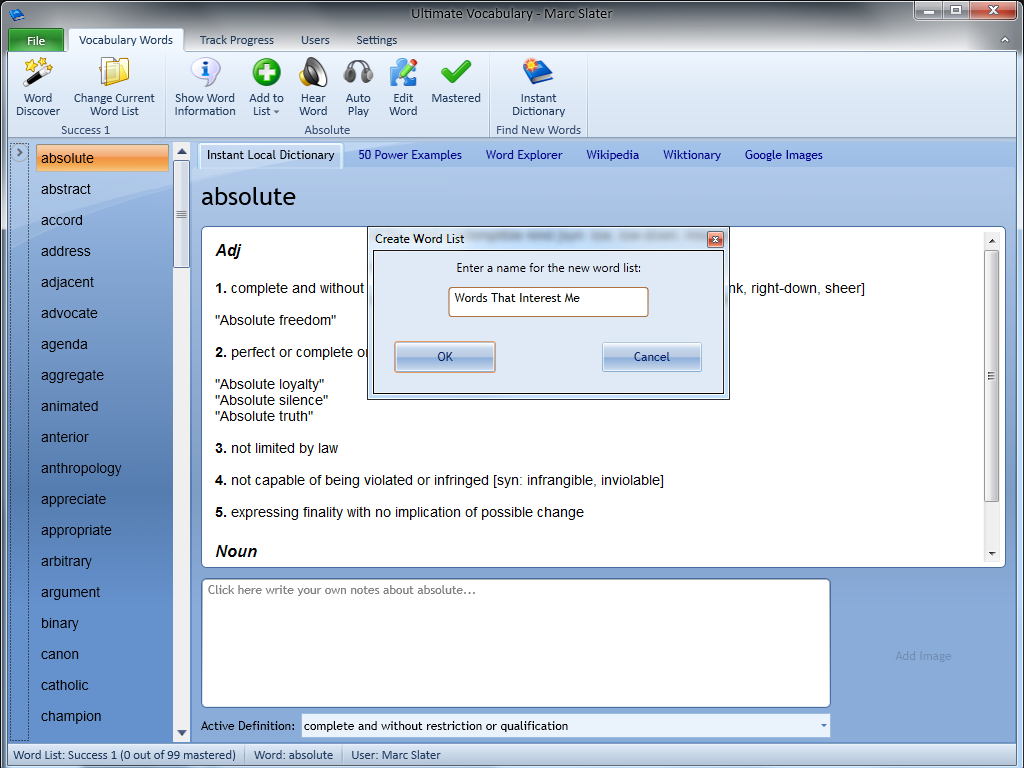
Make your own lists using any words you want to learn. Then let all of Ultimate Vocabulary’s activities, word databases, games, and tracking automatically go to work to teach you the words on your lists.
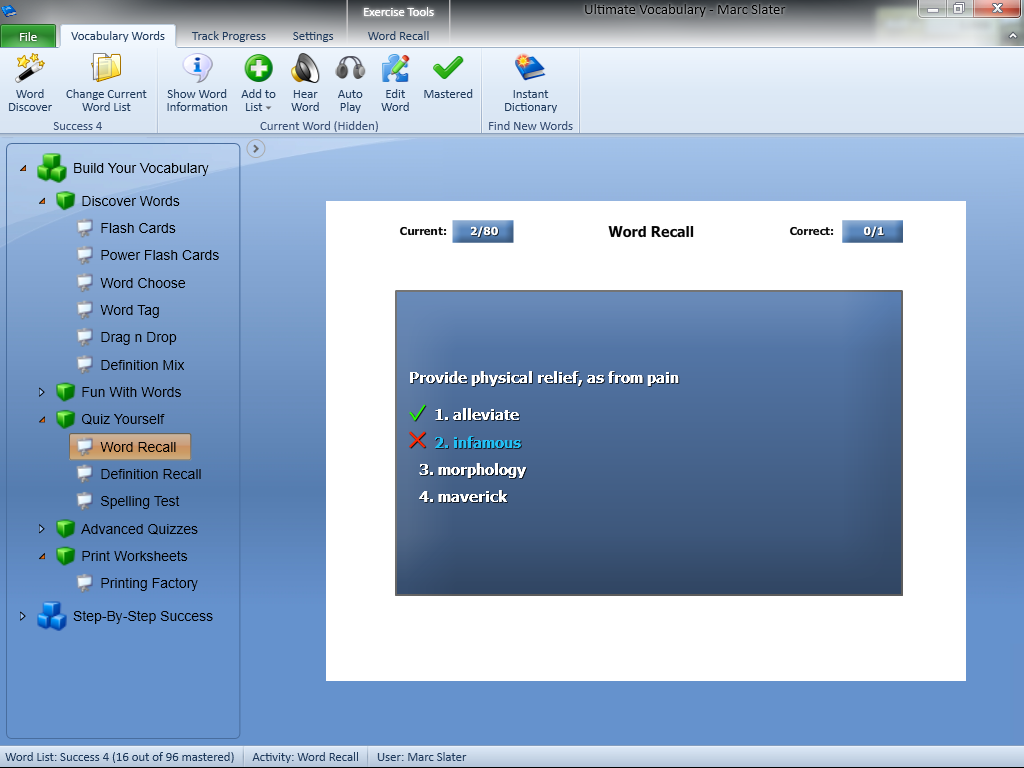
Your training program is customized to meet your specific needs.
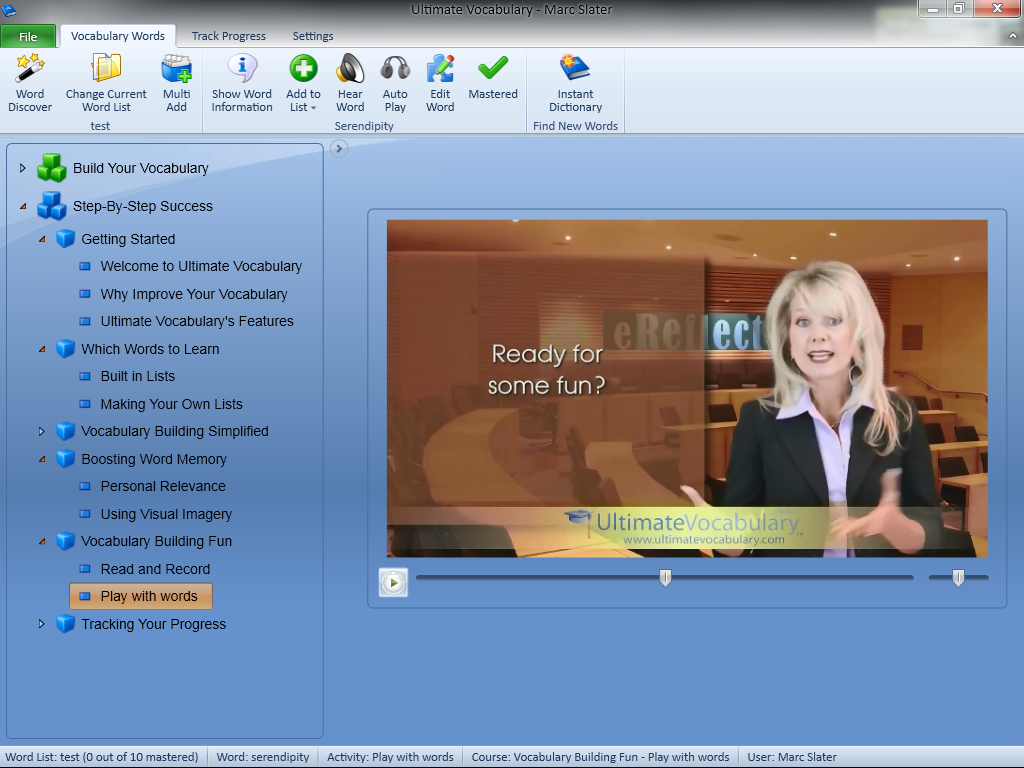
Learn from the world’s foremost vocabulary experts and you can be in the top 1% of communicators.
